
It’s no secret in real estate that, ultimately, price trumps all else. Every home will sell in a certain amount of time, at any given list price. Want to sell that mansion in Puslinch in twenty minutes? List it for $50,000. Don’t know why your 900 sq. ft. bungalow on Speedvale hasn’t sold in 9 years? It might be because you’re asking $750,000.
Extreme examples, sure. But it illustrates the point that the asking price, relative to the buyers’ perceived value of the house can have a profound impact on the time it takes to sell. When the list price exceeds perceived value, the house will sit on the market longer. If buyers see more value than the numerical value a seller puts on it, well then that’s where we see property move quickly.
The goal then, from a Realtor’s point of view is to strike the perfect harmony between a buyer’s willingness to pay and the sellers’ expectations and needs in terms of sale proceeds. Only in the rarest of circumstances, especially today, can a listing agent dupe buyers into paying more for a house than it’s worth. And sellers can be nieve in thinking otherwise. Just because, as a seller, you “need” a certain number for the house doesn’t mean there’s a single human on the planet who will give you that figure. Not to mention that today’s buyers are savvier than ever and shop loaded with information including: sale prices, days on market statistics, fact sheets on comparable properties and all sorts of other goodies readily accessible through a Realtor. The market, as a whole, doesn’t make mistakes.
Now that’s not to say that some sucker won’t. I’ve seen it before and I’ll see it a million more times where someone bought a house privately (*slams head into desk*), or on bad advice, and wound up paying way too much. But Buyer Representation Agreements, BRA’s for short, create a responsibility for agents to protect their buyer clients’ interests, and that includes not allowing them to overpay substantially without interjection & consultation. This means that as soon as a buyer locks in with their agent, your chance of taking them to the cleaners as a seller is virtually nil.
So, then, how do we manage to differenitate good agents from bad ones & smart sellers from suckers? A lot of it can boil down to the psychology behind a list price. The difference between a good deal & a bad deal is growing ever slimmer and outliers becoming more and more rare; but research has gone into strategizing a list price, and here’s what it says: The “just below” pricing model you see on listings every day generates greater sale prices than other pricing strategies.
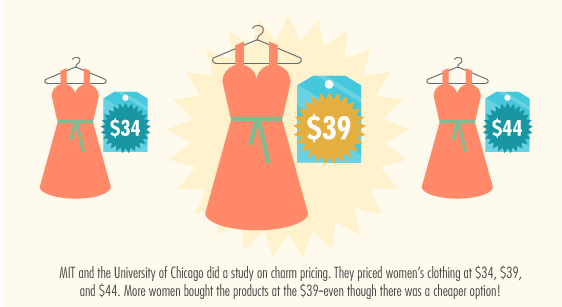
For the same reason McDonald’s charges $4.99 for a Big Mac, and everything at Wal-Mart costs $X.96; selling your home for just less than a given number can make all the difference.
In fact, evidence from a December Washington Post article suggests that this charm pricing strategy -to make the house look more affordable- can actually result in a seller receiving 2% more on average than homes using a different strategy. And while 2% might not sound like much, consider that most buyer or “co-operating” agents earn a 2-2.5% commission for representing the buyer. In essence, with this strategy, you can have a buyer brought to your door for free.
There were more than a few highlights to the story, which I’d highly recommend reading in full at the source. That said, in an effort to summarize both the article & my thoughts:
1. Ignore the urge to meet search criteria. In a very aware move, the researchers asked buyers for their take on homes priced at a dead-even number such as $300,000. In theory, with so many buyers using auto-search criteria & Realtor.ca price ranges, evenly priced houses might show up in a few more searches than their unevenly priced counterparts. At $300k for example, you might show up in searches from $250k-$300k & $300k-$325k; a perceived benefit. In reality, feedback from buyers suggested that they felt sellers were just ballparking their asking prices and weren’t sure what it was really worth. On the other hand, a $299,900 list price looked like a bargain.
Source: Econsultancy/Arie Shpanya, 2014
2. Charm pricing promotes over-pricing. Just like in “The Goods” starring Jeremy Piven (an unjustly underrated movie, FWIW), the product doesn’t need to be a good deal- it just needs to look like it is. List prices designed to feel like a bargain didn’t end up being one for buyers. In fact, they were more overpriced than employers of any other pricing strategy… to the tune of about 5% each time. In the movie, Piven’s character, Don Ready, employs the classic “put a higher price sticker on the windshield, just to tear it off and close the guy with a bargain” move that car salesmen are known for. Home sellers do it too, whether they know they are or not.
3. There’s a method to the madness. Only 45% of listings took the charm pricing approach; with others deviating to the round-number pricing to fit search criteria, or an exact price (ie. $239,588, as if to suggest they just added up a bunch of receipts and this is their number). I can appreciate the merits of the round number pricing as more buyers turn to rigid search criteria online, however, only houses worth near to a major round number would even qualify for this strategy. Charm pricing appears in nearly every segment of our lives as buyers, from groceries to cars to shoes (as if to suggest women look at the prices of shoes), and there’s a reason for it. It works. It generates sales, while blissfully pulling the wool over buyers’ eyes. And as sellers, there’s nothing more you could ask for.
 Real Estate Play-By-Play