Live-work buildings have a place in Guelph, but not at 15 Mont St.

Below is my contribution to the Guelph Citizen, published December 10th, 2014. The original article is here; and a counter-argument from the building’s architect can be read here.

Let me preface this argument by clarifying that it’s my firm belief that live-work apartments are an integral part of creating walkable cities, and intensifying city cores, as is Guelph’s directive. They have a positive impact towards reducing a city’s carbon footprint and improve density targets by better utilizing space in areas that are particularly starved by it.

Unfortunately, the developer planning to undertake 15 Mont St. has simply chosen the wrong battle. In reviewing the City’s zoning by-law and maps, it’s apparent that the corner of Mont and Woolwich is like many others in the downtown periphery. Many are zoned for office purposes along Woolwich, an arterial corridor, with low-density residential zoning along the side streets behind.

A 3-storey building currently occupies the corner of Mont and Woolwich, and is situated as far towards the eastern side of the property (towards Woolwich) as possible. 15 Mont St., the house whose existence hangs in the balance is placed on the westernmost side of its abutting property, creating the largest possible separation between the 2 buildings. This is often done to diminish shadow impact, noise pollution, etc., and is a fairly common design technique. It’s the same principles that are applied when deciding which types of development abut others; why factories don’t neighbour schools, for example.

The current three storey building at the corner of Woolwich and Mont


While still a relatively minor example of the instance above, an extension of the building at 360 Woolwich would envelop the majority of the lateral footprint of 15 Mont and have a detrimental impact on sightlines, noise and overall aesthetics, particularly affecting residents on the west end of Mont St. It’s important to additionally consider the style of the current office building and the virtual impossibility of incorporating the apartment addition in a way that blends at all naturally.

Furthermore, the property is located in an older, established area of the city. Live-work accommodations are more successful in the heart of the city, where amenities and employers are plentiful and directly accessible. The scale of the abutting office building is not to a level that would sustain the residential aspect of the development and tenants/owners would be no better served than a regular apartment building, for which the property is appropriately not zoned for.

mont2

The proposed development just in from the corner of Woolwich and Mont.


In summary, live-work buildings, when that’s what they are, are a major component of successful future growth in the City of Guelph. They do have a place though, and I don’t believe that place is 15 Mont St. Having said that, should this building go-ahead, I think it sets a whale of a precedent to accelerate future developments along the Gordon-Norfolk-Woolwich corridor, which in spots is an absolutely great thing for the city’s density targets and overall sustainability.

Tyson Hinschberger is a Realtor for Planet Realty Inc., Brokerage in the city of Guelph, Ontario. You can follow him on Twitter, @hinschcity. 

How Young Homebuyers Are Bucking the “Too Expensive” Narrative

“Home ownership is too costly.”

“We don’t make enough money.”

“Banks are biased against us.”

Regardless of validity, the reasons against ownership for young people are numerous. Despite them however, more and more are defying the excuses and converting their hard-earned paycheques into a piece of property to call their own.

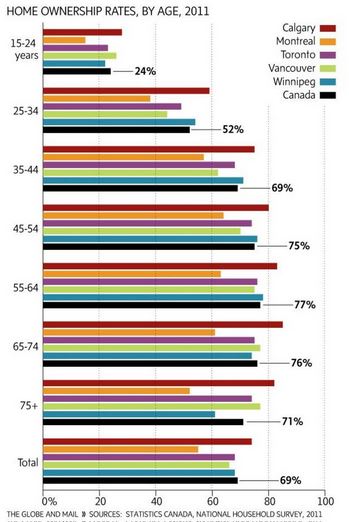
More and more young people are buying houses & condos, despite narratives to the contrary. From: The Globe & Mail

More and more young people are buying houses & condos, despite narratives to the contrary. From: The Globe & Mail

It’s a good thing they are too, as rates of home ownership tend to decline after age 65. While our demographics shift toward an older population, young buyers will be expected to fill that void. An inability to do so long-term could create a vast housing surplus, and drop property values across the board. So far though, it seems that the under-25 crowd are keeping things heading in the right direction.

Over the past decade and beyond, home values in some of the major urban cores have skyrocketed as land scarcity and foreign investment have pushed housing demand ever higher. It pits buyers of all kinds, especially young buyers with less accrued equity, in a tight spot. They’re being forced to compete with foreign, cash buyers using the Canadian real estate market as their own personal piggy bank, outside the grasp of their communist governments. Naturally, t’s a one-sided fight.

That said, in smaller markets, housing remains substantially more affordable; and the goal of home ownership much more attainable than the general overlying narrative. Furthermore, if buyers in Vancouver, Toronto and Montreal can buck the trend, then the same should be true across the board.

I hear people my age talk a lot about how expensive housing is, and what they don’t often consider is that there are landlords out there making positive cash flows off of them. In select instances, a landlord can lump mortgage costs, insurance and taxes together and still take his family out for a steak dinner on a tenant’s rent. So why then, aren’t young people more proactive about it?

Overall, we are finally catching on. In fact, home ownership among the youngest share of the population (Under 25’s) rose by 4% from 2006 to 2011 and now remains around 25% from the graphic above. To buyers’ benefits, price growth was minimally stunted by the US recession, aiding in affordability. However these gains come despite consistent upward price movement from the big 3 Canadian cities, and in ignorance of decreased affordability in those markets.

How is this possible?

Having established that, counter-intuitively, this generation’s ownership share’s been growing; it’s key to take a look at how. The biggest contributors are buyers’ parents, who are pitching in with down-payments more than ever before. From 2010-2014, first-time homebuyers received about 11% of down payments as gifts from family members, with another 6% coming from personal loans from family members. Though the loan share was unchanged from 2000-2004, the gifted portion is about 5% higher than 10 years ago. With average down payments equaling about 21% on first-time purchases, that 17% figure amounts to $10,080 on your average $300,000 home. For perspective, the house my grandparents bought in 1970 set them back a measly $10k to own it outright, so I guess $10,000 gifts are peanuts. It is understandable though that with the rise in values we’ve, the help from the folks is almost necessary to sustain the goals of today’s young shopper, and given that it’s been the parent’s houses who’ve seen the growth, we know the equity is there to be able to make these gifts, generally speaking.

As parents' aid pushes demand from D1 to D2, both the quantity demanded and the market price rise, furthering the handicap for those without family funding.

As parents’ aid pushes demand from D1 to D2, both the quantity demanded and the market price rise, furthering the handicap for those without family funding.

At the same time, parents are artificially fueling the fire. By adding $10,000 to the budgets of a growing market share, parents are effectively promoting the ballooning of home prices. As illustrated here, these gifts that young buyers are stumbling into is resulting in more buyers entering the market, and buyers’ budgets being greater than they might otherwise be. This in itself creates a bit of a dangerous predicament, since some buyers are being aided by their parents while others are not, and this price shift pushes the latter further from their ownership goals. The Canadian Association of Accredited Mortgage Professionals disputes the impact that parents are having on prices, but consider this: With 1/3 of 18- to 35-year olds who haven’t bought a home attributing the decision to waiting for prices to drop; how will they ever drop if parents keep pumping in money? Answer: They won’t. Even if you don’t have the help, use parents supporting the market as a way to make your house purchase work for you.

Housing is like any investment. You have to pay to play, and you’re not going to make a cent off of it unless you buy something. The people that complain certain stocks are too expensive are the ones who sat on the sideline didn’t buy in when they were affordable. There are elements of risk involved, but you can continue to pay rent to a landlord or you can cut out other expenses to make home ownership a reality. It’s a decision that more and more young people are making sacrifices to pursue. And I can’t blame them for a second.


With statistics from (Links in post):

“How young Vancouver buyers are crashing the real estate party”, Frances Bula, Globe and Mail, October 17, 2014.

“1st time home buyers get more family help for down payment”, CBC News, November 18, 2014.

“I WANT TO BUY A CONDO…


Coletara's latest Guelph condo under construction- Ten77

Coletara’s latest Guelph condo under construction- Ten77

…But I don’t know what, how or why I should buy.”

For many first-time buyers (nearly all, if we’re talking about Toronto), downsizing seniors and empty nesters, condo living is a desirable option –if not far & away the best.

For those who have never owned a home, condo ownership is essentially Home Ownership Lite. Instead of doing all the maintenance and undertaking the personal expense of a freehold home, you pay into a communal pot that takes care of most of the upkeep you’d normally have to do yourself. This is especially great if you’ve always lived at home. It gives you the chance to learn things like how to make Kraft Dinner and how an iron works, without tying yourself up worrying about the expense of a leaky roof or how not to kill a garden full of hostas & geraniums.

If you’ve owned your home for many years, I don’t need to tell you how quickly the Honey-Do list becomes a multi-page pipe dream. Besides, now that the kids are gone, it’s time for Mom & Dad to forego the house work and head down to Mexico and the island barstools with your names on them. Condo living is the paramount option for those of us who just want to lock the door and take off for weeks or months at a time. Not to mention that the communal property maintenance doesn’t eat into your time on the golf course.

So, however your condo wish came to be, I’m here to help make it a reality. With over 150 condominium transactions’ worth of both new and resale experience, I know that whichever style of condo you’re looking for, I can get you into something that’s exactly what you’re looking for.

I’ve created a package, in which you’ll find some key forms to help you differentiate various condo options as well as a glossary for terms that you may have never encountered before. There are a number of things (ie. The reserve fund) that are not necessarily public knowledge or easily accessible. That’s where the value of a good Realtor and hard-working lawyer can be of tremendous service to you. All you have to do is ask and we’re happy to track down that information on any listing you might find on Realtor.ca, in a newspaper or just by driving around the area. Remember that as a buyer, you pay no commission, as it is the seller’s responsibility to pick up that tab. Use the professional help that’s there for the taking.

If you’re ready to get started, that’s fantastic. All you have to do is give me a call and we can work as a team to take it from there. I can’t wait to hear from you.

First-Time Buyers: Mortgages, Part One

Yeah. Part One.

Mortgages are quite the animal, so there’s a lot to know before you dive right into one. They’re also not super exciting, so it’s probably for the best that we split it up. We don’t need anyone giving up 2000 words in when we touch on collateral for the 8th time.

I figure we’re best to start with how to determine what we’ll qualify for, and then get into manipulating & expanding that number if your budget doesn’t suit your must-have list in Part Two.

8342940With real estate prices climbing ever higher, seemingly across the board, the Conservative government under Finance Minister Jim Flaherty made an array of changes to artificially cool the housing demand in 2012, reducing the risk of a bubble and simultaneous crash as seen south of the border. Despite it being against traditional Conservative financial policy to tamper with free markets, the government implements these new measures and made home ownership more difficult for first-time buyers and others alike.

The argument, naturally, is that the consumers affected by these changes likely shouldn’t have been buying properties anyway, since their situations were associated with higher risks of defaults and foreclosures. Personally, I feel these situations are better assessed on a person-to-person basis in terms of who can adapt their situations and survive rate hikes or reductions in income. At the same time, you have to respect the government applying the same rules to everyone, though it hurts people who otherwise could’ve managed.

In determining how much you can afford to spend on a home, lenders typically focus on two main ratios. Gross Debt Service, or the amount of the liabilities tied to your home, is currently capped at 39%. This means that the amount of your proposed mortgage payments plus your condo fees (if applicable), property taxes, and utilities should not exceed 39% of your household income. Total Debt Service, the more critical number, is also capped at 44%.This includes the aforementioned GDS components, but also any other personal liabilities you may have. Student loans, credit card debts, lines of credit and car loan payments are the most common additional charges in the TDS calculation. Typically a lender will look for these ratios to be at 32% at 40% respectively, which can be increased to the maximum based on high credit scores. We’ll address those in part two.

A major reason I feel the Flaherty changes were unnecessary is due to the little known benchmark, or qualifying rate. If you’ve never bought a home before, chances are you’ve never heard of this number, the one that likes to deflate expectations for new mortgagors. Here’s a tip: If you’re looking into properties to purchase and you use the mortgage calculator on a website/app like Realtor.ca, use the benchmark interest rate to qualify yourself, as that’s what your lender will be forced to use as well. Even though your ratios may be strong at an interest rate of 2.5% on a 5 year variable rate mortgage, you’ll have to have favourable GDS & TDS ratios based on the higher rate. The benchmark rate, which is the 5-year term fixed posted rate (currently 5.34%) is in place to protect against rate hikes, effectively the same thing Flaherty’s changes were put in place to do.

Once you’ve established what you believe you can afford, the process of choosing your actual mortgage begins. Comparison shopping is essential, and one of the best ways to do this is through a mortgage broker. Ben Melick of Mortgage Intelligence (Kitchener-Waterloo), Randy von Heyking of Mortgage Alliance and Rob Campbell of the Mortgage Wellness Group (Guelph) are all stand-up options for you to consult. It’s not even a bad idea to consult with one before you try and figure out what you can afford. They’ll help you through it. Mortgage brokers understand each product available and can point you in the direction of the product that’s right for you. If you already do all your banking and investing with the same major bank, they could also be a good option for you, since that can typically give you some leverage either for mortgages or other services. They’re not always the lowest rates, in fact they’re usually not, but at least you can be comfortable in having a one-stop shop for your finances and they can easily be managed all at once. That said, if you’re indifferent between loyalties to a bank and trying a mortgage broker, watch this CBC Marketplace episode (Segment 2, about 5 minutes) on big bank mortgages and go from there. It should help you make up your mind.

In Part Two we’ll look at credit scores: how they’re calculated, their impact and how to improve them; various types of incomes and how lenders view them; co-signers, which more and more of us have; mortgage insurance and high-ratio premiums vs. low-ratio mortgages. Let’s be honest though, mortgage posts can only be so long.

Which Renovations Should I Do Before I Sell? Probably None.

One of the most common questions I get from potential home sellers is: Should I do “project x” or leave it for the next owner? It’s not necessarily clear cut, but if you’re going to do something, you’ve got to do it well, and have buyers perceive it as better than the alternative. If you’re contemplating upgrading your linoleum flooring to higher-end linoleum, you might as well be taking cash from an ATM and stuffing it down a manhole. Things buyers would consider doing anyways (updating appliances, stone countertops, tearing out carpets for hardwood) are the way to create value.

Buyers these days have more refined taste than ever before, but often you’ll find two types of buyers: Those that want to save money and buy a home they can renovate, and those that are prepared to pay, so long as they don’t have to lift a finger once they move in. If you’re setting your home up to be somewhere in between these two markets, you’re destined to lose. With the former, they’re not typically willing to pay for things they’re just going to do over again. And buyers looking for turn-key homes don’t really care if the home is flashy if it isn’t cohesive.

For example, I went through a house with a re-done kitchen just this week and though the kitchen couldn’t have been but a few months old, the house still took on the “fixer-upper” stigma because of outdated doors & trim, holes in the drywall and ageing structural and mechanical components. There’s a difference between a “wow factor” (a term I hate, personally.) and lipstick on a pig. And it’s important to know whether buyers will see your reno work as the former or the latter.

In the Village by the Arboretum in Guelph, an adult-lifestyle community where I spend a lot of my time and resources, some sellers have installed new carpets, which they perceive as value-added finishes. After all, they often spend money to put in high-quality, plush carpets, and have them professionally installed. Unfortunately, most incoming buyers will see them as disposable as they look to upgrade to hardwood floors, and a detriment to the home. Despite the money put into new carpeting, the home is likely no more valuable in a buyer’s eyes, whereas it could’ve been had sellers made the move to hardwood prior to selling.

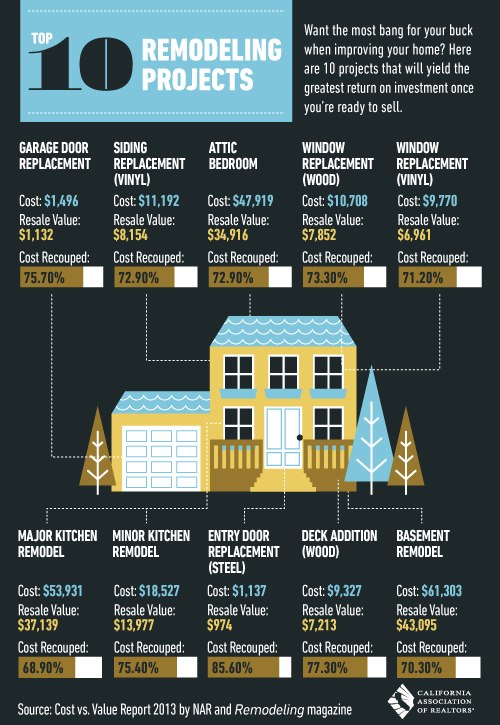
This infographic from the California Association of Realtors shows 10 key home renovation projects and the return on investment. One thing they all have in common: none generate a positive ROI. Odds are, most of the time, you won’t recoup the full cost of the reno. It’s not always explicit though. Sometimes, a house can be nearly impossible to sell with an outdated kitchen or a slew of mechanical issues, which makes some renovations necessities. Without some of the necessary renos, you’ll lose more money by reducing the price of a house that sits for sale without any action. That kind of situation makes dropping a few thousand dollars to make the home more saleable the best way to go. It’ll result in a faster sale, if not at a higher price point.

renoreturns

Before you choose to do any of the renovations you have in mind, have a Realtor conduct a market analysis on your home and the surrounding area. They can help advise you as to what kind of improvements will benefit you, and which will leave your bank account reeling. They can tell you the returns on those upgrades for your neighbourhood, and help you determine if they’re a project worth undertaking. Do the homework before you start and see the best returns, plain and simple.

First-Time Buyers: Down Payments

Soon-to-be first-time buyer? Well, that’s me. And based on this blog’s readership, there’s an 80% chance that’s you too.

It’s a grind. Believe me. If you’ve looked into buying your first house, you understand the weight of your decision (hopefully); and if not, you’ll realize when you look for the first time. As many of us battle along, whether under the ominous cloud of a student loan or the pain-staking job search in a slowly recovering market, it’s important to keep our goals in mind. The pressures of the current day-to-day can detract from our ability to see our endgame.

For many of us, that next big goal is home ownership. It’s an ever-evolving need, but a strong investment in our futures at the same time. It’s a shelter for our earnings, a store of value, a forced savings, and our greatest chance to build equity in ourselves. The type of home and where it’s located can vary for us over the years, but the equity we build up in it will follow us throughout our lives.

So how do we start? Well, man, that’s a tough one. It’s hard to say, given that we’re all unique in our situations. Some of us have jobs, but tens of thousands in student loans. Some of us don’t have the loans, but can’t find that job that’ll take us to the next level. And for the select few that have managed to string it all together so far, congrats.

The hardest part is saving for the down payment, I think everyone can agree on that. Buying a home on budget is pretty easy, and you can adjust your price range accordingly. It’s coming up with that extra chunk of money that gets in the way for a lot of people. In a recent TD survey, up to 60 percent of first-time buyers weren’t satisfied with the size of their down payments. Not only does a larger down payment make for smaller mortgage payments, it reduces the amount of mortgage insurance you’re liable for, plus it makes refinancing easier when the time comes. This is an interesting catch-22. On one hand, most folks would rather own a home sooner and stop paying someone else’s mortgage. But at the same time, a smaller down payment is a handicap of sorts, and makes the budget that much tighter on a monthly basis. The trade-offs are never crystal clear.

There’s no magic number for a down payment, but there are 2 key thresholds: 5% and 20%. 5% is the absolute minimum down payment you’ll need to make on your home, and 20%, the minimum amount required to avoid mandatory mortgage insurance. Breathe at 5, shoot for 20. And though it can seem like a bit of a daunting task at times, the majority of people don’t expect the extra savings to take too long. Once you establish the routine of saving, and get to a point where you can put extra cash aside, it only gets easier.

It’s like losing weight. Sure, it’s tough to start a new routine or regimen, but once you find your groove, it’s all gravy. Low-fat, tofu gravy.

So if you’re at the point where you think your first purchase is on the horizon, let’s have a chat. A real estate agent can help you set those goals and establish a budget. And who better to have on your side than friend, in the same boat, who’ll work for you for free? I’m here to help. Let’s get started.

Is an Income Property Right for Me?

Not literally, guys.

Didn’t mean that literally, guys.

Real estate investing has never been sexier.

Whether its the rock bottom American home prices creating opportunities, the volatile stock market, or the bargain basement interest rates available to home buyers, real estate has become an investment haven for more and more people. It also doesn’t hurt that the media has promoted real estate investment through a wider array of programming featuring home flips, renovations and other ways to maximize a home’s utility.

If you’re considering investing in real estate, you have a few options at hand. If you’re a hands-on type investor, you can control your own destiny with an income property. If you like sitting back and watching your money work for you, something like a REIT could be right up your alley.

The growth of REITs (Real Estate Investment Trusts) is a clear indication of investors’ urges to profit from a strong Canadian real estate market. REITs are a great option for those looking to earn dividends on their stocks, as by law, REITs are required to pay back 90% of their taxable income to investors. They are as liquid as stocks; have preferential taxation rules; and have been on an absolute tear lately, soaring in value. Canadian REITs have recently been generating dividend yields (dividends per share/share price) in the area of 9-12% annually, due to growth and that required payout.

EDIT: REIT’s have slowed as of late, but from 2010 to year-end 2012, the S&P/TSX Capped REIT Index produced annual returns from the sector of 19.7%. Annually.

Even with those statistics, income properties have become a hot topic too. You’ve likely watched a contractor’s show where they convert a basement or run-down duplex into a cash cow. If it made you want to get in on the action, you’re not alone. Instances of second-property ownership are on the rise, and the federal government has recently taken action to make sure that this influx of investors is under control; in that people aren’t buying multiple properties and getting themselves into high-risk, low-equity scenarios. Owning another property is different from investing into a third-party, in that ultimately you control where your dollars go and how they’re used. It’s more direct, hands-on and you control your own destiny.

When looking to purchase a second property, there are a number of considerations that need to be made. Essentially, you’re becoming an entrepreneur. You’ll soon be generating revenues and paying expenses just like any other company. REITs do well when they have tenants, and lose with vacancies. When owning a second place yourself, full occupancy should boost your income potential beyond that of the average REIT, but extended vacancies can cripple your finances. Fortunately, the needs of tenants are easy to predict, with little changing on a year to year basis. Basically, if you’re able to find a place that works for tenants, you can milk that cash cow for an extended period of time.

In a “university town” like Guelph, many people enter the market looking to purchase student rental property. Here, those properties span from London Road to Clair, from Victoria to Imperial, and with each location offering unique amenities to their potential tenants, they’ve proven successful in a variety of neighbourhoods. Which location you buy in will determine the ease of finding tenants; and just like homeowners, renters can have different opinions of value and different criteria for an ideal place. Common “wants” within the student community can include: Access to transit, proximity to the university campus, ease of access to downtown, updated units, newer buildings; the list goes on and on. Knowing your target market will help you find the best locations, most suitable units, and how to generate rents that meet your goals.

How good are you as a property manager? Sometimes a firm understanding of accounting or finance might be help you with the ins and outs of generating a return, but how are your people skills? Keeping tenants for an extended stay is cheaper than finding new ones, so the daily operations of your property can be critical. Make sure you’re up to the task. If not, consider hiring a property management firm. They’ll take between 5-10% of your rental income, but they can relieve a lot, if not all of the hassle. They handle maintenance, rent collection and can save you money by finding qualified, well-suited tenants on your behalf. And if your decision to buy is hanging on by that 5-10%, the second-property route might be a little risky anyways.

Ultimately, you’re the one making the decision, and nobody knows your skills, tendencies and comfort level better than yourself. That said, it’s always a good idea to consult an expert before you make a play. Talk with your financial planner, mortgage agent and a Realtor; and then decide whether direct or indirect real estate investment is the smarter play for you.

What’s my home worth? This flyer told me I should know.

You know what people hate? Junk mail.

You know what some Realtors love to send people? Junk mail.

I’m sure there are more than a few people wondering what’s involved in one of those “free home evaluations” that you always get a flyer for. Hell, I got two this week (Sorry fellow agents, I threw them out), they must be important. Truth is home evaluations are actually a pretty handy marketing tool for agents, and useful knowledge for homeowners.

Are us Realtors really just giving away services? How do we make money?

As a seller, you've got a few options...

As a seller, you’ve got a few options…

Well, a home evaluation or “complementary market analysis” is a gateway, commonly referred to as a loss leader. They’re like a kids eat free promotion at a restaurant that gets hefty, football-watching, mammoth dads through the door to throw back a giant slab of meaty goodness for $30. Sure you lose out on the 5 bucks from little Jimmy’s grilled cheese and fries, but he’s not paying the bills or making the decisions. Realtors spend the time, for free, to scout your home and harvest you as a prospective client. Then they make that money back down the road on the sale of your home when you inevitably call them because they’ve established a relationship with you. This isn’t a tactic or scheme, it’s smart business. You’re not tied to them at all, so you’re still free to use whoever you’d like. It’s just that you’re more likely to call them, and they now know your home better than any other agent.

Keep in mind that as we go along here, there’s a difference between Realtors and appraisers. A Realtor can quickly give you a very good estimate of your house’s value, often from experience alone. It serves to come up with an attainable list price for your home that the market would be willing to pay. Realtors are often immersed in the marketplace on a daily basis and have a good sense of market conditions. Despite being accurate very often, they are certainly an opinion and the market will react as it will when the time comes. And, just like any business, you may get one or two “professionals” who are off-base, so make sure you do a little homework to pick someone well-qualified (Sidebar: I am well-qualified). It won’t hurt to get a second opinion if you feel the first is out of line.

There are 3 main methods of appraisal: the cost approach, sales comparison approach, and the income approach. The instances where each are used vary, and typically all home evaluations are done via a single means, due to their accuracy and consideration of timing.

The one you’re least likely to see is the income approach, unless you’re selling a multi-unit dwelling from which you garner regular revenues. It is mostly used for commercial and industrial valuations, and involves the use of discount rates and cash flows to determine a reasonable price to generate a sufficient return for the buyer. If comparable properties to the one we’re trying to price have a discount rate around 8%, and our unit brings in $24,000/year, then our value would be $300,000 ($24,000/0.08).

Still with me? Remember, that one doesn’t get used often. If you’re already lost, then I’ve done my selling job and made you need me even more. Excellent.

The second method -one that can be used more frequently in residential valuations- is the cost approach. Effectively, it equates to the cost to replicate the building, if the buyer were to build it to its current condition. It considers the value of the property, and then adds the cost of improvements, before also accounting for depreciation.

Here’s a VERY simplified example:

If a house was worth $250,000, and the seller installed a $10,000 rec room theatre system with a 20 year life, 3 years ago, the cost approach would then re-value the house at $258,500.

Make sense? The trouble with this method is that upgrades rarely see the true cost returned to a seller. If a house goes from a dump to fully-turnkey, there may be a profit margin for the seller. Often though, if there is more work to be done, buyers will see that before the true value of renovations. It is also hard to gauge land value premiums, and incorporate those true costs, since the available for vacant land, particularly in subdivisions, has been slim for many years.

So let’s take a look at the one your Realtor will do for you, since it’s the one that you’re probably most interested in.

The sales comparison approach is what you’ll get when you bring in a Realtor, be it from junk mail or their awesome, informative blog posts- either or. It’s the most effective way of determining market conditions on a city-by-city, neighbourhood-by-neighbourhood, street-by-street basis. Using information that they alone can access, Realtors are able to determine the market value of your home by comparing a number of variables within your home, to others that have sold previously.

A Realtor will develop a list of similar properties called “comparables”, and adjust their estimate of your home’s value by the differences in those homes and the subsequent changes in price associated with those differences. Some common variables include, but are certainly not limited to: the number of bedrooms and bathrooms, square footage, sale date and house style, all of which can have a large impact on the price of the house. With the development of subdivisions and model homes, it’s become even easier to find accurate comparables, since identical layouts and floor plans are used in multiple homes in the same area. Sometimes, variables such as how well a home shows to potential buyers requires putting a dollar value on a qualitative impression. That quantifying ability comes from experience and knowledge of what attracts buyers, along with what buyers are willing to pay for…and ultimately, how much.

Here’s an purely hypothetical example that illustrates the sales comparison approach. Again, it’s very simplified, but hey.

Mike’s house has 3 bedrooms, 2 baths, 1800 square feet and is a 2-storey detached house in the Westminster Woods neighbourhood.

Now, a value is determined for each variable, which is then roughly applied to the price of the best comparables. This can be done using common market estimates of value, or for the most specific info, by virtue of a regression analysis. For the purposes of the example, we’ll say that bedrooms are worth $25,000;  full baths are $20,000; space is valued at $50/sq. ft., and comparable home prices have gone up an average of $24,000 in the past year.

So, with that taken into consideration, Mike’s Realtor finds that a good comparable for his home is another two-storey detached home sold in Westminster Woods, 4 months ago. It had 4 bedrooms, 2.5 bathrooms and was 1920 square feet. It sold for it’s full asking price of $465,000.

Here is where being decent at math is a big plus. You’d first subtract $25,000 from that price to account for the drop from 4 bedrooms to 3; then take off another $10k for the half-bath Mike doesn’t have. By also having 120 less square feet, the Realtor would drop $6,000 off the $465,000 as well. It’s not all bad news for Mike though. Given the strong market and home values rising $2,000/month, Mike can expect $8,000 more than he would’ve got if the houses had sold at the same time.

Therefore, we can see the value estimate as follows: $465,000-$25,000-$10,000-$6,000+$8,000= $432,000. Even though his house was valued at $432,000, Mike would probably factor some negotiating room into his listing price. For that reason, Realtors are invaluable, since the sale price should be a much greater consideration than the listing price, which is often all the public has access to.

Every house has a price, but finding the right one, right away, is the key to a quick, hassle-free sale. If you comparison shop Realtors and get multiple estimates before listing your home, keep in mind that the highest one isn’t necessarily the best. It might be, and your house may sell for that. But overpricing your house can be dangerous, since a house that sits develops a stigma and can often sell for less than it otherwise may have if priced correctly at the beginning.

Realtors are an invaluable resource when it comes to selling your home. A home evaluation can be helpful to homeowners, even before the time comes to sell. It can help establish a budget for your next purchase, and plan for your future. For a free home evaluation, call me at 519-837-0900, or just wait for anyone to drop a flyer in your mailbox. I know which one I’d choose.

How To Ruin Your Landlord’s Sale

Wow, what a week so far. The cat’s away, but it means this mouse has a ton more work to do to cover. Sorry that you’re just getting this now.

I’ve been through a lot of houses in my day. Growing up, with both my mom and grandmother in the industry, I spent a lot of time in model homes. Granted, most of that time was spent being bored out of my skull, but it probably skewed my expectations of what homes were supposed to look like.

Not every home can be a model home. We don’t all have the money to hire designers, stagers and other “make it look pretty” specialists. Some day I’ll do a post explaining the merits of using these folks when it comes time to sell, but that’s for another day.

Whenever someone lists their home for sale, a good agent will spend some time advising them of the little things they can do to make their home more saleable. The number one item on said list is, almost always, tidying up. A clean home will always show better than a messy one, and if nothing else, will keep the potential buyer in a pleasant mood walking through your place. It doesn’t have to show like those model homes, most buyers won’t have that expectation. It should however, look like something someone would want to buy.

So what happens when you’re selling a home that you don’t live in? Landlords put a lot of trust in their tenants to make their living quarters show-worthy. And from experiences, tenants couldn’t give less of a damn.

It’s one thing to keep a clean house because you should. It’s much more enjoyable: Fresh smells, open space, readiness to entertain when the mood strikes, etc. If that’s not your thing, fine, understood, we all let our place go here and there.

It’s another thing altogether when the person whose house you’re living in asks you to do them a solid and you blatantly disregard their request. I mean hey, if you pay your $400 bucks for a summer room, you should get to do whatever you want, that’s what the $400’s for right? Put a hole in a wall or two, slap up some Element stickers on your bedroom door, go to town. (Sidenote: Show of hands for anyone who’s seen stickers on a door/wall/window and been like, “Wow, that looks great, I should definitely do that”.) It’s an absolute disgrace what some of these tenants do, and it’s probably going to mean that the houses we saw won’t be moving any time soon.

So here are two houses I’ve seen this week:

The University House, Waterloo

This thing was as a pure a student ghetto hellhole as I’ve seen. I got to tour student rentals a ton in university, and this thing took the cake. Great price for fully licensed, registered duplex, but no MLS pictures- sign number 1 that this wasn’t going to be a great time. If you’ve got nothing to hide, you’re definitely putting pictures of the place on MLS, so let’s suffice to say that I wasn’t going to be blown away the interior.

Well I was, but not in a great way. After knocking (tenants may or may not be home), I let myself in with the key from the lockbox. Announced myself. Nothing. Okay, we’re good to go here.

First room- Living room. Great size. They’ve got 4 chairs huddled around a little flat screen and two couches on either side of a coffee table. At least I think it was a coffee table, it was covered in garbage that I didn’t really notice because my eyes were drawn to 2 things. The first, this hunting knife in a sleeve. Terrifying on it’s own.

Super terrifying on a stack of movies like Slash. 

Welcome to our home! Stay a while?

Welcome to our home! Stay a while?

Yeah, okay. It’s at this point that I’m torn between how utterly ridiculous and amazing it is to find this chilling on someone’s coffee table, and how I should’ve been an accountant, never finding myself here in the first place.

Sure enough, now I hear footsteps. I’m kidding myself right? I mean, totally psyching myself out after seeing this stuff. I turn around to the doorway on the right. It’s the kitchen. Through the doorway on the wall is a rack. A rack of more knives. Just hanging there, waiting for whoever’s making these footsteps to come put them to good use.

At this point I’ve noticed 3 things: the living room layout, The Stabber’s Beginners Kit, and a wall of knives he can graduate up to.

Fun. And now footsteps guy peeks around the corner.

“Hey,” says a lanky kid with glasses. Anticlimactic as anything.

“Uh, hey, how’s it going chief? Just here for the 11 o’clock showing, mind if I look around?”

“I guess. The one guy’s bedroom’s locked, and the other guy’s in the shower.”

Awesome. Hey, I gave you guys about 40 hours’ notice I was coming and you picked now to shower? And your pal couldn’t leave the door open? Great. I quickly learn that there are 6 rooms on this floor, and I can’t see a third of them.

I get the idea from the 4 I can see and make my way downstairs to the shared laundry. A fairly new washer and dryer are a nice surprise. +1. (I think that brings us to -12)

I knock entering the second unit downstairs. Guy pops out of his pitch black room asking if he can help me. Obviously didn’t get the memo. Not only that, but he goes back in after announcing himself and closes the door. Just going to assume that room was a palace and move on. The “kitchen” downstairs -which the listing said included a stove- had no stove. A microwave and a sink. A Kraft Dinner maker and some water to wash your bowl with.

Two more bedrooms painted in kindergarten green and I was over this place. Not something my customer was looking for. There wasn’t a living room in the basement, which makes it harder to rent to groups anyway. For as awful as the house was, the guys inside it could’ve cleaned up, and at the very least, not done their best to creep the hell out of me.

A great introduction to the world of showing student rentals to say the least.

The Off-Scottsdale Rental, Guelph

I can’t say exactly where this house is, given that it’s still on the market, but it’s in a primarily student-rental neighbourhood off of Scottsdale in Guelph. I showed it Tuesday night… in the pouring rain…with the wrong lockbox combination. Needless to say, after 2 phone calls and 5 minutes in the downpour, we were already regretting our decision to take a look. It didn’t get a whole lot better from there.

The house was an exact replica of my first student house on Sidney Cres., which was nice in that I’d know where everything was. We started the main floor tour in the kitchen, lined with next-to-empty 40’s of bargain bin liquor. I guess when you live close to an LCBO but not a Beer Store, the bottles tend to pile up. You can get them easily but it’s just such an inconvenience to take them anywhere, let alone just recycle.

The rest of the main floor was pretty vanilla, so we knocked on the basement door. Just music. Knock again.

“WHAT?”

“Oh, hey, just here for the showing.” I turn to my client who’s thinking exactly the same thing: Upstairs first.

Luckily the upstairs did the trick.

The first room, a bathroom, was quite the treat. I never quite understood how people lived with toilet paper scraps all over the floor or, for that matter, how they get there in the first place. Is it sheer boredom? The only thing worth doing while you’re on the john is tearing up paper and littering your floor? That’s what Angry Birds and Fruit Ninja were designed specifically for.

This. Pretty much.

This. Pretty much.

There was a bedroom with nothing in it; a second bedroom with sheets and a few cases worth of Pure Life bottles scattered all over; and a third bedroom, locked, with a TV clearly audible and nobody willing to let us in. Grand.

This place had a great backyard and the deck was custom-built to fit a hot tub, which was noticeably absent. Ultimately it was shame that my buyer didn’t like the house, because the lot and layout would’ve been fantastic.

Sometimes it’s hard to see past cosmetics. It’s always hard to buy something you can’t even see. Put them together, and the recipe for the sale isn’t there 9 times out of ten. It’s like accidentally using salt instead of sugar. It’s disappointing and leaves a bad taste in your mouth.

Where do we put the students?

Student housing to parents.

Student housing to parents.

I use the term “we” very loosely as not 12 months ago, I was one of these “students” (read: messy, loud, rude vermin). And even though the debate raged in the media throughout my 4-year tenure at the University of Guelph, nobody seemed to put forward any concrete suggestions as to how to appease the student population or the long-term residents of various neighbourhoods.

Student housing to neighbours.

Student housing to neighbours.

Living in the Westminster Woods neighbourhood at the south-end, I was lucky enough that my neighbours had no ill-will towards myself or my roommates, at least that we were aware of. We were clean, respectful and -save for special occasions- dead quiet. Take a survey though, and you’d get the impression that we were in the heavy minority.

University towns like Guelph, Kingston and Waterloo are inevitably going to have a large rental population in the surrounding neighbourhoods. Given that most students operate on tight budgets and thus don’t rely on a car, this student distribution is heavily centred within the immediate vicinity of the school or along bus corridors. So, if you live close to a school, chances are, you’ll have students living on your street: it’s Urban Economics 101.

Rather than turn the Mayfield Park area, or the Gordon St. Corridor into the second coming of Queen’s student ghetto, we have to look at some progressive alternatives to the currently dysfunctional student-resident relationship. Personally, my experiences with the student-resident dynamic have been quite positive. But that doesn’t mean other students and owners haven’t gotten into it over things like taunting a goose with a ball. It seems like there can’t be pleasing everyone until they’re separated like toddlers on a timeout.

So how do we separate them? Where do the students go?

The ever-popular student destination in Guelph is Edinburgh Village. A world all its own, Edinburgh Village is home to only students and is isolated by a major road, forest, farmland and a plaza in each direction. They do really well at filling their sizeable development with students year-after-year. And not only do they fill it, they charge above-market rents to the tune of $550 per room, per month. Plus utilities. How? Location, location… you’ve heard it a million times. A short jaunt along a weather beaten “cow path” and you’d find yourself at the University in a matter of minutes.

So, if students will pay this much to live in an apartment, with a residence atmosphere and paper walls; is it so shocking that they’d flock to Mayfield Park and Old University which are both equally proximate, quieter, more spacious and the same price or cheaper?

No. At least not to me. I don’t think it would be to you either. It’s not exactly rocket scientist (-Deena, Jersey Shore). Sorry.

A rendering of Abode's proposal

A rendering of Abode’s proposal

Well then, along comes Abode Varsity Living to a chorus of boos from residents. Wait, what? They’re going to build a place to put the students that live among you and it’s not welcome? NIMBYism at its finest.

“We don’t want students living on our street, can’t you put them somewhere like a residence?”

“NO! Don’t build that residence THERE!”

And this is why real estate development is a pain-staking, drawn out process. It’s been 2 and half years since Abode submitted their proposal to the City of Guelph to re-zone and re-develop the lands currently housing a Best Western hotel and conference centre spot on the corner of Gordon St. & Stone Road, the gateway to Mayfield Park. Save for the scale of the project, I don’t understand why this isn’t a great location for a ton of students. Guelph has a floundering tourism industry, which, for all this city has, isn’t one of its finest efforts. So why not make better use of the property which has already served as a satellite residence for first-year students at peak times?

Well, suffice to say that the OMB (Ontario Municipal Board) ruled very much in favour in Abode’s proposal, despite the objections of both the City of Guelph and the Mayfield Park Residents’ Association, who was also party to the decision and fully armed with counsel and precendent. It just makes sense. If you want the students to “go away”, you need somewhere to put them. And since they are paying for it themselves, you’re going to have to make it somewhere they want to go.

So, we end up with a high-density, student-centric development closer to moving ahead; and at the cost of only a few years’ time, thousands and thousands of dollars & boatloads of grief for everyone. All to save a couple units and maybe a floor or two.  Was it worth it? For Abode, certainly. For the city, and Mayfield Park? It’ll depend on what the final design looks like, but I’m leaning towards a solid no on this one.