
How To Ruin Your Landlord’s Sale

Wow, what a week so far. The cat’s away, but it means this mouse has a ton more work to do to cover. Sorry that you’re just getting this now.

I’ve been through a lot of houses in my day. Growing up, with both my mom and grandmother in the industry, I spent a lot of time in model homes. Granted, most of that time was spent being bored out of my skull, but it probably skewed my expectations of what homes were supposed to look like.

Not every home can be a model home. We don’t all have the money to hire designers, stagers and other “make it look pretty” specialists. Some day I’ll do a post explaining the merits of using these folks when it comes time to sell, but that’s for another day.

Whenever someone lists their home for sale, a good agent will spend some time advising them of the little things they can do to make their home more saleable. The number one item on said list is, almost always, tidying up. A clean home will always show better than a messy one, and if nothing else, will keep the potential buyer in a pleasant mood walking through your place. It doesn’t have to show like those model homes, most buyers won’t have that expectation. It should however, look like something someone would want to buy.

So what happens when you’re selling a home that you don’t live in? Landlords put a lot of trust in their tenants to make their living quarters show-worthy. And from experiences, tenants couldn’t give less of a damn.

It’s one thing to keep a clean house because you should. It’s much more enjoyable: Fresh smells, open space, readiness to entertain when the mood strikes, etc. If that’s not your thing, fine, understood, we all let our place go here and there.

It’s another thing altogether when the person whose house you’re living in asks you to do them a solid and you blatantly disregard their request. I mean hey, if you pay your $400 bucks for a summer room, you should get to do whatever you want, that’s what the $400’s for right? Put a hole in a wall or two, slap up some Element stickers on your bedroom door, go to town. (Sidenote: Show of hands for anyone who’s seen stickers on a door/wall/window and been like, “Wow, that looks great, I should definitely do that”.) It’s an absolute disgrace what some of these tenants do, and it’s probably going to mean that the houses we saw won’t be moving any time soon.

So here are two houses I’ve seen this week:

The University House, Waterloo

This thing was as a pure a student ghetto hellhole as I’ve seen. I got to tour student rentals a ton in university, and this thing took the cake. Great price for fully licensed, registered duplex, but no MLS pictures- sign number 1 that this wasn’t going to be a great time. If you’ve got nothing to hide, you’re definitely putting pictures of the place on MLS, so let’s suffice to say that I wasn’t going to be blown away the interior.

Well I was, but not in a great way. After knocking (tenants may or may not be home), I let myself in with the key from the lockbox. Announced myself. Nothing. Okay, we’re good to go here.

First room- Living room. Great size. They’ve got 4 chairs huddled around a little flat screen and two couches on either side of a coffee table. At least I think it was a coffee table, it was covered in garbage that I didn’t really notice because my eyes were drawn to 2 things. The first, this hunting knife in a sleeve. Terrifying on it’s own.

Super terrifying on a stack of movies like Slash. 

Welcome to our home! Stay a while?

Welcome to our home! Stay a while?

Yeah, okay. It’s at this point that I’m torn between how utterly ridiculous and amazing it is to find this chilling on someone’s coffee table, and how I should’ve been an accountant, never finding myself here in the first place.

Sure enough, now I hear footsteps. I’m kidding myself right? I mean, totally psyching myself out after seeing this stuff. I turn around to the doorway on the right. It’s the kitchen. Through the doorway on the wall is a rack. A rack of more knives. Just hanging there, waiting for whoever’s making these footsteps to come put them to good use.

At this point I’ve noticed 3 things: the living room layout, The Stabber’s Beginners Kit, and a wall of knives he can graduate up to.

Fun. And now footsteps guy peeks around the corner.

“Hey,” says a lanky kid with glasses. Anticlimactic as anything.

“Uh, hey, how’s it going chief? Just here for the 11 o’clock showing, mind if I look around?”

“I guess. The one guy’s bedroom’s locked, and the other guy’s in the shower.”

Awesome. Hey, I gave you guys about 40 hours’ notice I was coming and you picked now to shower? And your pal couldn’t leave the door open? Great. I quickly learn that there are 6 rooms on this floor, and I can’t see a third of them.

I get the idea from the 4 I can see and make my way downstairs to the shared laundry. A fairly new washer and dryer are a nice surprise. +1. (I think that brings us to -12)

I knock entering the second unit downstairs. Guy pops out of his pitch black room asking if he can help me. Obviously didn’t get the memo. Not only that, but he goes back in after announcing himself and closes the door. Just going to assume that room was a palace and move on. The “kitchen” downstairs -which the listing said included a stove- had no stove. A microwave and a sink. A Kraft Dinner maker and some water to wash your bowl with.

Two more bedrooms painted in kindergarten green and I was over this place. Not something my customer was looking for. There wasn’t a living room in the basement, which makes it harder to rent to groups anyway. For as awful as the house was, the guys inside it could’ve cleaned up, and at the very least, not done their best to creep the hell out of me.

A great introduction to the world of showing student rentals to say the least.

The Off-Scottsdale Rental, Guelph

I can’t say exactly where this house is, given that it’s still on the market, but it’s in a primarily student-rental neighbourhood off of Scottsdale in Guelph. I showed it Tuesday night… in the pouring rain…with the wrong lockbox combination. Needless to say, after 2 phone calls and 5 minutes in the downpour, we were already regretting our decision to take a look. It didn’t get a whole lot better from there.

The house was an exact replica of my first student house on Sidney Cres., which was nice in that I’d know where everything was. We started the main floor tour in the kitchen, lined with next-to-empty 40’s of bargain bin liquor. I guess when you live close to an LCBO but not a Beer Store, the bottles tend to pile up. You can get them easily but it’s just such an inconvenience to take them anywhere, let alone just recycle.

The rest of the main floor was pretty vanilla, so we knocked on the basement door. Just music. Knock again.

“WHAT?”

“Oh, hey, just here for the showing.” I turn to my client who’s thinking exactly the same thing: Upstairs first.

Luckily the upstairs did the trick.

The first room, a bathroom, was quite the treat. I never quite understood how people lived with toilet paper scraps all over the floor or, for that matter, how they get there in the first place. Is it sheer boredom? The only thing worth doing while you’re on the john is tearing up paper and littering your floor? That’s what Angry Birds and Fruit Ninja were designed specifically for.

This. Pretty much.

This. Pretty much.

There was a bedroom with nothing in it; a second bedroom with sheets and a few cases worth of Pure Life bottles scattered all over; and a third bedroom, locked, with a TV clearly audible and nobody willing to let us in. Grand.

This place had a great backyard and the deck was custom-built to fit a hot tub, which was noticeably absent. Ultimately it was shame that my buyer didn’t like the house, because the lot and layout would’ve been fantastic.

Sometimes it’s hard to see past cosmetics. It’s always hard to buy something you can’t even see. Put them together, and the recipe for the sale isn’t there 9 times out of ten. It’s like accidentally using salt instead of sugar. It’s disappointing and leaves a bad taste in your mouth.
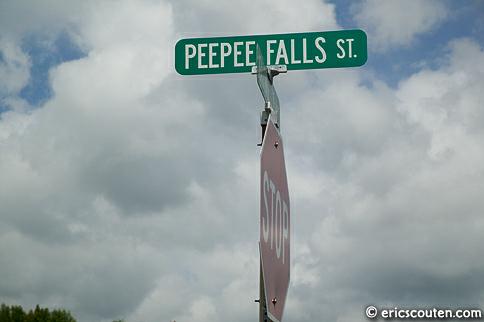

What’s in a street name?

Ever see a street sign and wonder how much, or how little thought went in to coming up with it?

These days, many subdivisions have themed names- The Village By The Arboretum for example, rolls through a series of tree-centric names from front to back. But then there’s the odd street like Hands Drive that makes you wonder what the story behind the name is. Surely there’s a story. I mean, there’s no way -short of tossing random nouns in a hat- that someone could just come up with that.

So, is that a consideration for you? Could you live on a street with a name that annoyed you?

Turns out that not only do the names of streets matter to people, but the street suffix has a marked impact on the sale price of homes too.

Trulia.com, an American real estate site took a look at over 2.5 million listings in their database and took the median PPSF (Price Per Square Foot) among prominent street suffixes. Here’s what they found (The percentages are each suffix’s share of the total number of properties analyzed):

  • Boulevard, 2%, $117.
  • Place, 2%, $110.
  • Road, 16%, $109.
  • Way, 3%, $107.
  • Terrace, 1%, $102.
  • Court, 6%, $101.
  • Lane, 8%, $101.
  • Circle, 3%, $100.
  • Trail, 1%, $97.
  • Avenue, 15%, $96.
  • Drive, 22%, $96.
  • Street, 19%, $86.
Streets like this contribute to the disparity.

Streets like this contribute to the disparity.

The biggest shocker here is undoubtedly the cost to live on the relatively generic “roads”. I don’t tend to equate “roads” with premium residential housing. To me, “terraces” and “courts” tend to suggest more luxurious accommodations, but what do I know?

Trulia was nice enough to offer some explanation for the pricing of homes on boulevards:

“Why is ‘boulevard’ the most expensive address suffix? Well, while the word does have a sophisticated French origin, it actually might have more to do with the mix of the homes located there. Approximately, 37% of homes on ‘boulevards’ are in multi-unit buildings, such as apartments and condos. In contrast, these types of homes make up no more than 16% of homes on every other address suffix. A greater concentration of multi-unit buildings could drive up costs as they are often located in denser, urban areas where space is at a premium.”

That city centre justification holds water for me. The smaller a home’s footprint, the greater PPSF you’ll end up paying, regardless of where it’s located. But especially when they’re located in urban centres, property in general will outpace that of the suburbs.

I’ve lived on a “drive”, a “street”, a “crescent” (which apparently isn’t as popular in the States as it is here), an “avenue” and a “road”. And while the “avenue” was the nicest by far, I can understand why the “street” is worth significantly less than all the others.

It was a far busier street than any of the others, and the house was dated. How dated you ask? We had a milk box. Exactly. A mail box but for milk, so when Ol’ Johnny came whistling along in his half-sized Purolator truck, he could set you up with a fresh supply of 2%.

The perception of street suffixes is a worthwhile consideration when buying a home, but ultimately, this study is better taken at face value. Nobody is going around writing off homes on XYZ Street based on a suffix. Either a house is on a busy street, in an urban core, with mature trees, or it isn’t. Still, this study reveals some pretty neat data on what street names tend to suggest.

Where do we put the students?

Student housing to parents.

Student housing to parents.

I use the term “we” very loosely as not 12 months ago, I was one of these “students” (read: messy, loud, rude vermin). And even though the debate raged in the media throughout my 4-year tenure at the University of Guelph, nobody seemed to put forward any concrete suggestions as to how to appease the student population or the long-term residents of various neighbourhoods.

Student housing to neighbours.

Student housing to neighbours.

Living in the Westminster Woods neighbourhood at the south-end, I was lucky enough that my neighbours had no ill-will towards myself or my roommates, at least that we were aware of. We were clean, respectful and -save for special occasions- dead quiet. Take a survey though, and you’d get the impression that we were in the heavy minority.

University towns like Guelph, Kingston and Waterloo are inevitably going to have a large rental population in the surrounding neighbourhoods. Given that most students operate on tight budgets and thus don’t rely on a car, this student distribution is heavily centred within the immediate vicinity of the school or along bus corridors. So, if you live close to a school, chances are, you’ll have students living on your street: it’s Urban Economics 101.

Rather than turn the Mayfield Park area, or the Gordon St. Corridor into the second coming of Queen’s student ghetto, we have to look at some progressive alternatives to the currently dysfunctional student-resident relationship. Personally, my experiences with the student-resident dynamic have been quite positive. But that doesn’t mean other students and owners haven’t gotten into it over things like taunting a goose with a ball. It seems like there can’t be pleasing everyone until they’re separated like toddlers on a timeout.

So how do we separate them? Where do the students go?

The ever-popular student destination in Guelph is Edinburgh Village. A world all its own, Edinburgh Village is home to only students and is isolated by a major road, forest, farmland and a plaza in each direction. They do really well at filling their sizeable development with students year-after-year. And not only do they fill it, they charge above-market rents to the tune of $550 per room, per month. Plus utilities. How? Location, location… you’ve heard it a million times. A short jaunt along a weather beaten “cow path” and you’d find yourself at the University in a matter of minutes.

So, if students will pay this much to live in an apartment, with a residence atmosphere and paper walls; is it so shocking that they’d flock to Mayfield Park and Old University which are both equally proximate, quieter, more spacious and the same price or cheaper?

No. At least not to me. I don’t think it would be to you either. It’s not exactly rocket scientist (-Deena, Jersey Shore). Sorry.

A rendering of Abode's proposal

A rendering of Abode’s proposal

Well then, along comes Abode Varsity Living to a chorus of boos from residents. Wait, what? They’re going to build a place to put the students that live among you and it’s not welcome? NIMBYism at its finest.

“We don’t want students living on our street, can’t you put them somewhere like a residence?”

“NO! Don’t build that residence THERE!”

And this is why real estate development is a pain-staking, drawn out process. It’s been 2 and half years since Abode submitted their proposal to the City of Guelph to re-zone and re-develop the lands currently housing a Best Western hotel and conference centre spot on the corner of Gordon St. & Stone Road, the gateway to Mayfield Park. Save for the scale of the project, I don’t understand why this isn’t a great location for a ton of students. Guelph has a floundering tourism industry, which, for all this city has, isn’t one of its finest efforts. So why not make better use of the property which has already served as a satellite residence for first-year students at peak times?

Well, suffice to say that the OMB (Ontario Municipal Board) ruled very much in favour in Abode’s proposal, despite the objections of both the City of Guelph and the Mayfield Park Residents’ Association, who was also party to the decision and fully armed with counsel and precendent. It just makes sense. If you want the students to “go away”, you need somewhere to put them. And since they are paying for it themselves, you’re going to have to make it somewhere they want to go.

So, we end up with a high-density, student-centric development closer to moving ahead; and at the cost of only a few years’ time, thousands and thousands of dollars & boatloads of grief for everyone. All to save a couple units and maybe a floor or two.  Was it worth it? For Abode, certainly. For the city, and Mayfield Park? It’ll depend on what the final design looks like, but I’m leaning towards a solid no on this one.

Barrier Reef Getaway- just a cool £75 Million

Do you have $150 million burning a hole in your pocket? Those low interest rates probably aren’t doing you any favours, so why not invest it in a chunk of the Great Barrier Reef?

Daydream Island, off the coast of Queensland, Australia is up for sale for the first time since 2000; as the current owner is planning on cashing out and retiring. £75 million should probably last him a few years…

What to get the billionaire who has everything: Tropical island on the Great Barrier Reef goes on sale for £75million -Daily Mail

  • Daydream Island off the coast of Queensland in Australia hosts 300-room luxury hotel with attached spa
  • Getaway offers snorkelling, jet-skiing and miles of lush golden beaches as well as world’s largest man-made reef

Record: The island boasts the world's largest man-made coral lagoon enabling guests to get up close and personal with tropical fish

The perfect gift for the billionaire who has everything has just come on the market – an idyllic tropical island tucked away in the Great Barrier Reef.

However, the Australian island is far from being a deserted getaway, as it hosts a 300-room luxury hotel and spa.

Daydream Island in Queensland, near the Whitsunday Islands, has doubtless shot to the top of the shopping list for the mega-rich after going up for sale for £75million.

The 4km-long island is covered in lush rainforest, and features the world’s largest man-made coral reef lagoon.

Its hotel boasts a private golden beach for each guest, and the outdoor aquarium features 50 different corals and 80 types of sea life.

Moguls who are keen to enjoy snorkelling, jet-skiing, scuba diving and other aquatic activities will be keen to stake their claim to be the new owner of Daydream Island.

Paradise: Arriving visitors are greeted by an array of palm trees by the jetty as they first reach Daydream Island

Flamboyant businessman Vaughan Bullivant snapped up the island in 2000, and is now hoping to hand it on to another entrepreneur after his retirement.

‘But I’m 65 now and looking to at some stage put my feet up and enjoy doing other things in life including more travel and spending time with my family, which has long been my goal,’ he said.

‘I intend to make sure that Daydream remains an industry leader and am looking for a suitable operator to take Daydream Island forward.’

Resort boss Phil Casey said that the island had never looked better, and claimed that its natural beauty had helped it thrive throughout the recession.

‘Daydream Island has just completed a very positive 12 months of trading which is extremely pleasing considering the tourism industry has had a very difficult time in recent years,’ he said.

‘The island’s management has worked hard to position Daydream as an Australian holiday destination of choice.

‘Visitors are voting with their feet and giving fabulous feedback about our beautiful island and the great times they are having there.’

He insisted the resort would not be sold to just anyone, and said he was confident the island would find a proprietor who is a good fit for the beautiful getaway.