Looking Ahead: Canada’s 2014 Olympic Hockey Roster

I think I did the same thing.

I think I did the same thing.

We all remember where we were that fateful February evening in 2010.

I was in the living room of my student rental in Guelph. I vividly recall sharing stunned disappointment with 5 of my best friends watching Zach Parise take the Gold Medal Game to overtime with a scrappy, dirty goal as the clock wound down.

More so, though, I remember the pure, unparalleled elation that followed a short time later. The “Iggy!” cry. The 5-hole squeeze by Ryan Miller that was just a touch too slow. The Sidney Crosby corner jump, crowd-screaming, gloves-flying celebration that comes with a victory of that calibre. A joy that only comes along once in a while. We were the best. And there’s no better feeling than being the best.

In 2002, when Canada ended its 52 year gold-less drought, my Grandpa and I took to the streets of downtown Kitchener. I waved a huge Canadian flag out the passenger window while we sat in a slow parade of King St. traffic, soaking it all in. It was amazing. One of my favourite childhood memories.

Naturally, we recreated the feeling again in 2010. Downtown Guelph was buzzing, justifiably so. We broke the horn on my old ’97 Monte Carlo, whaling on it while people screamed and cheered on the sidewalks and in the bars.

To say that the Olympics are just another hockey tournament would be a massive understatement. It’s easy to see just how big a deal it is, not only for the players but for the entire country. Winning those 2 hockey games did arguably more for our nation’s psyche than any other event over the past 11 years.

It goes without saying then, that the team in charge of selecting the upcoming 2014 Olympic hockey roster has their work cut out for them. Pressure? Yeah, they’ve got a ton of it. And unlike any other hockey team, this one has 33 million fans expecting them to win. Hardly a cakewalk with the hockey world as competitive as ever.

So, given that I have no pressure to include, or not include whoever I want, I thought I’d put together my own team. Just for fun, here’s a look at my picks for the upcoming 2014 Sochi roster:

Forwards

Not too many remain from the team that took home the gold in 2010. Some ageing players from that team are no longer in their prime, and while still beyond serviceable in the NHL, aren’t as mobile as in years past. With the international tournament being played on the larger ice surface used overseas, that speed and agility is paramount when competing with the European teams (See: Miracle). This means the likes of Jarome Iginla, Joe Thornton, Dany Heatley and Pat Marleau don’t crack my roster. This opens room for a couple young players with a pedigree of World Junior Championship success. This is what I project the lines to look like:

Steven Stamkos- Sidney Crosby- Martin St. Louis

Claude Giroux- Jonathan Toews- Patrick Sharp

Corey Perry- Eric Staal- James Neal

Taylor Hall-John Tavares- Jordan Eberle

Patrice Bergeron

The kid line of Taylor Hall, Jordan Eberle and John Tavares has the chance to be a difference maker in the tournament. They’ve piled up points and been clutch on the international stage for Canada before. The Perry-Staal-Neal line is very much a puck-possession line. It features 2 sizey, prolific goal-scorers centred by another big guy with tremendous vision. I had Rick Nash in Neal’s spot, but decided that if coming through under pressure mattered, Neal’s successes of late far trump those of Nash.

The top two lines both feature elite skill and scoring prowess. The second-line features 3 versatile guys who can put up points while being strong in their own zone. The first? Well, between them they have 3 Art Ross trophies (Most Points), 3 Rocket Richard trophies (Most Goals) and is simply a combination of the 3 best players in the NHL last season. Hands down.

The forward units aren’t structured like the NHL clubs. The players are all elite-level talents, no grinders or enforcers to be found. Even Patrice Bergeron in the 13th spot is capable. Though he finds himself in the same “extra man” role he played in 2010, expect big things from him as he can jump into any spot in the lineup if the need arises.

Defence

Canada has always been known as a strong defensive team. Even in 1998 in Nagano, when Canada didn’t medal, the team featured 6 of the 7 best Canadian defencemen of the last 20 years. Consider though, that with the game being played on larger ice, even a D corps featuring Rob Blake, Ray Bourque, Adam Foote, Chris Pronger, Al MacInnis and Scott Stevens in their prime would be scrambling to keep up. These are my picks to fill the 7 back-end spots:

Shea Weber- Kris Letang

Alex Pietrangelo- Drew Doughty

Duncan Keith- Brent Seabrook

Pernell Karl Subban

There are some fantastic skaters in this mix, to say the least. I’d deem Seabrook and Weber the least mobile of the set, and even then, it’s hardly a drawback. Every single one of these guys can play on both sides of the puck, and when the latest Norris winner is the 7th-best defenceman on your team, you’re in pretty good shape.

Goaltending

This one’s pretty easy. I get to pick 3 of maybe a half-dozen or so potential candidates, only 2 of which are really standouts.

Roberto Luongo

Carey Price

Corey Crawford

Seen as Canada’s most glaring weakness, let’s just remember that we won gold with Roberto Luongo last time around as well. Granted, it may have been as much in spite of him as was because of him, the fact remains that his performance was…sufficient. We’ll go with that.

Luongo figures to be Canada’s game 1 starter, with Carey Price the clear-cut #2 option, if not a solid 1B. These two guys are essentially locks to make the team. The third spot is up in the air between 3 other goalies: Mike Smith, Corey Crawford, and Braden Holtby; who you figure might’ve made the cut as Marc-Andre Fleury played his way out of a spot in the last two post-seasons. I give the nod to Crawford based on the stellar numbers he put up this season, backstopping the Blackhawks to the Stanley Cup. Plus, if we win, we might get the chance to hear another one of his off-colour parade speeches. And wouldn’t it be glorious. All we have to do now is win the thing.

Note: If I’m way off base, let me know in a tweet or comment. For another opinion, check out my pal Brandon Decoppel’s (@bdecoppel) Team Canada roster: http://bdecoppel.wordpress.com/2013/07/22/sochi-14-my-team-canada-roster/

First-Time Buyers: Down Payments

Soon-to-be first-time buyer? Well, that’s me. And based on this blog’s readership, there’s an 80% chance that’s you too.

It’s a grind. Believe me. If you’ve looked into buying your first house, you understand the weight of your decision (hopefully); and if not, you’ll realize when you look for the first time. As many of us battle along, whether under the ominous cloud of a student loan or the pain-staking job search in a slowly recovering market, it’s important to keep our goals in mind. The pressures of the current day-to-day can detract from our ability to see our endgame.

For many of us, that next big goal is home ownership. It’s an ever-evolving need, but a strong investment in our futures at the same time. It’s a shelter for our earnings, a store of value, a forced savings, and our greatest chance to build equity in ourselves. The type of home and where it’s located can vary for us over the years, but the equity we build up in it will follow us throughout our lives.

So how do we start? Well, man, that’s a tough one. It’s hard to say, given that we’re all unique in our situations. Some of us have jobs, but tens of thousands in student loans. Some of us don’t have the loans, but can’t find that job that’ll take us to the next level. And for the select few that have managed to string it all together so far, congrats.

The hardest part is saving for the down payment, I think everyone can agree on that. Buying a home on budget is pretty easy, and you can adjust your price range accordingly. It’s coming up with that extra chunk of money that gets in the way for a lot of people. In a recent TD survey, up to 60 percent of first-time buyers weren’t satisfied with the size of their down payments. Not only does a larger down payment make for smaller mortgage payments, it reduces the amount of mortgage insurance you’re liable for, plus it makes refinancing easier when the time comes. This is an interesting catch-22. On one hand, most folks would rather own a home sooner and stop paying someone else’s mortgage. But at the same time, a smaller down payment is a handicap of sorts, and makes the budget that much tighter on a monthly basis. The trade-offs are never crystal clear.

There’s no magic number for a down payment, but there are 2 key thresholds: 5% and 20%. 5% is the absolute minimum down payment you’ll need to make on your home, and 20%, the minimum amount required to avoid mandatory mortgage insurance. Breathe at 5, shoot for 20. And though it can seem like a bit of a daunting task at times, the majority of people don’t expect the extra savings to take too long. Once you establish the routine of saving, and get to a point where you can put extra cash aside, it only gets easier.

It’s like losing weight. Sure, it’s tough to start a new routine or regimen, but once you find your groove, it’s all gravy. Low-fat, tofu gravy.

So if you’re at the point where you think your first purchase is on the horizon, let’s have a chat. A real estate agent can help you set those goals and establish a budget. And who better to have on your side than friend, in the same boat, who’ll work for you for free? I’m here to help. Let’s get started.

Is an Income Property Right for Me?

Not literally, guys.

Didn’t mean that literally, guys.

Real estate investing has never been sexier.

Whether its the rock bottom American home prices creating opportunities, the volatile stock market, or the bargain basement interest rates available to home buyers, real estate has become an investment haven for more and more people. It also doesn’t hurt that the media has promoted real estate investment through a wider array of programming featuring home flips, renovations and other ways to maximize a home’s utility.

If you’re considering investing in real estate, you have a few options at hand. If you’re a hands-on type investor, you can control your own destiny with an income property. If you like sitting back and watching your money work for you, something like a REIT could be right up your alley.

The growth of REITs (Real Estate Investment Trusts) is a clear indication of investors’ urges to profit from a strong Canadian real estate market. REITs are a great option for those looking to earn dividends on their stocks, as by law, REITs are required to pay back 90% of their taxable income to investors. They are as liquid as stocks; have preferential taxation rules; and have been on an absolute tear lately, soaring in value. Canadian REITs have recently been generating dividend yields (dividends per share/share price) in the area of 9-12% annually, due to growth and that required payout.

EDIT: REIT’s have slowed as of late, but from 2010 to year-end 2012, the S&P/TSX Capped REIT Index produced annual returns from the sector of 19.7%. Annually.

Even with those statistics, income properties have become a hot topic too. You’ve likely watched a contractor’s show where they convert a basement or run-down duplex into a cash cow. If it made you want to get in on the action, you’re not alone. Instances of second-property ownership are on the rise, and the federal government has recently taken action to make sure that this influx of investors is under control; in that people aren’t buying multiple properties and getting themselves into high-risk, low-equity scenarios. Owning another property is different from investing into a third-party, in that ultimately you control where your dollars go and how they’re used. It’s more direct, hands-on and you control your own destiny.

When looking to purchase a second property, there are a number of considerations that need to be made. Essentially, you’re becoming an entrepreneur. You’ll soon be generating revenues and paying expenses just like any other company. REITs do well when they have tenants, and lose with vacancies. When owning a second place yourself, full occupancy should boost your income potential beyond that of the average REIT, but extended vacancies can cripple your finances. Fortunately, the needs of tenants are easy to predict, with little changing on a year to year basis. Basically, if you’re able to find a place that works for tenants, you can milk that cash cow for an extended period of time.

In a “university town” like Guelph, many people enter the market looking to purchase student rental property. Here, those properties span from London Road to Clair, from Victoria to Imperial, and with each location offering unique amenities to their potential tenants, they’ve proven successful in a variety of neighbourhoods. Which location you buy in will determine the ease of finding tenants; and just like homeowners, renters can have different opinions of value and different criteria for an ideal place. Common “wants” within the student community can include: Access to transit, proximity to the university campus, ease of access to downtown, updated units, newer buildings; the list goes on and on. Knowing your target market will help you find the best locations, most suitable units, and how to generate rents that meet your goals.

How good are you as a property manager? Sometimes a firm understanding of accounting or finance might be help you with the ins and outs of generating a return, but how are your people skills? Keeping tenants for an extended stay is cheaper than finding new ones, so the daily operations of your property can be critical. Make sure you’re up to the task. If not, consider hiring a property management firm. They’ll take between 5-10% of your rental income, but they can relieve a lot, if not all of the hassle. They handle maintenance, rent collection and can save you money by finding qualified, well-suited tenants on your behalf. And if your decision to buy is hanging on by that 5-10%, the second-property route might be a little risky anyways.

Ultimately, you’re the one making the decision, and nobody knows your skills, tendencies and comfort level better than yourself. That said, it’s always a good idea to consult an expert before you make a play. Talk with your financial planner, mortgage agent and a Realtor; and then decide whether direct or indirect real estate investment is the smarter play for you.

What’s my home worth? This flyer told me I should know.

You know what people hate? Junk mail.

You know what some Realtors love to send people? Junk mail.

I’m sure there are more than a few people wondering what’s involved in one of those “free home evaluations” that you always get a flyer for. Hell, I got two this week (Sorry fellow agents, I threw them out), they must be important. Truth is home evaluations are actually a pretty handy marketing tool for agents, and useful knowledge for homeowners.

Are us Realtors really just giving away services? How do we make money?

As a seller, you've got a few options...

As a seller, you’ve got a few options…

Well, a home evaluation or “complementary market analysis” is a gateway, commonly referred to as a loss leader. They’re like a kids eat free promotion at a restaurant that gets hefty, football-watching, mammoth dads through the door to throw back a giant slab of meaty goodness for $30. Sure you lose out on the 5 bucks from little Jimmy’s grilled cheese and fries, but he’s not paying the bills or making the decisions. Realtors spend the time, for free, to scout your home and harvest you as a prospective client. Then they make that money back down the road on the sale of your home when you inevitably call them because they’ve established a relationship with you. This isn’t a tactic or scheme, it’s smart business. You’re not tied to them at all, so you’re still free to use whoever you’d like. It’s just that you’re more likely to call them, and they now know your home better than any other agent.

Keep in mind that as we go along here, there’s a difference between Realtors and appraisers. A Realtor can quickly give you a very good estimate of your house’s value, often from experience alone. It serves to come up with an attainable list price for your home that the market would be willing to pay. Realtors are often immersed in the marketplace on a daily basis and have a good sense of market conditions. Despite being accurate very often, they are certainly an opinion and the market will react as it will when the time comes. And, just like any business, you may get one or two “professionals” who are off-base, so make sure you do a little homework to pick someone well-qualified (Sidebar: I am well-qualified). It won’t hurt to get a second opinion if you feel the first is out of line.

There are 3 main methods of appraisal: the cost approach, sales comparison approach, and the income approach. The instances where each are used vary, and typically all home evaluations are done via a single means, due to their accuracy and consideration of timing.

The one you’re least likely to see is the income approach, unless you’re selling a multi-unit dwelling from which you garner regular revenues. It is mostly used for commercial and industrial valuations, and involves the use of discount rates and cash flows to determine a reasonable price to generate a sufficient return for the buyer. If comparable properties to the one we’re trying to price have a discount rate around 8%, and our unit brings in $24,000/year, then our value would be $300,000 ($24,000/0.08).

Still with me? Remember, that one doesn’t get used often. If you’re already lost, then I’ve done my selling job and made you need me even more. Excellent.

The second method -one that can be used more frequently in residential valuations- is the cost approach. Effectively, it equates to the cost to replicate the building, if the buyer were to build it to its current condition. It considers the value of the property, and then adds the cost of improvements, before also accounting for depreciation.

Here’s a VERY simplified example:

If a house was worth $250,000, and the seller installed a $10,000 rec room theatre system with a 20 year life, 3 years ago, the cost approach would then re-value the house at $258,500.

Make sense? The trouble with this method is that upgrades rarely see the true cost returned to a seller. If a house goes from a dump to fully-turnkey, there may be a profit margin for the seller. Often though, if there is more work to be done, buyers will see that before the true value of renovations. It is also hard to gauge land value premiums, and incorporate those true costs, since the available for vacant land, particularly in subdivisions, has been slim for many years.

So let’s take a look at the one your Realtor will do for you, since it’s the one that you’re probably most interested in.

The sales comparison approach is what you’ll get when you bring in a Realtor, be it from junk mail or their awesome, informative blog posts- either or. It’s the most effective way of determining market conditions on a city-by-city, neighbourhood-by-neighbourhood, street-by-street basis. Using information that they alone can access, Realtors are able to determine the market value of your home by comparing a number of variables within your home, to others that have sold previously.

A Realtor will develop a list of similar properties called “comparables”, and adjust their estimate of your home’s value by the differences in those homes and the subsequent changes in price associated with those differences. Some common variables include, but are certainly not limited to: the number of bedrooms and bathrooms, square footage, sale date and house style, all of which can have a large impact on the price of the house. With the development of subdivisions and model homes, it’s become even easier to find accurate comparables, since identical layouts and floor plans are used in multiple homes in the same area. Sometimes, variables such as how well a home shows to potential buyers requires putting a dollar value on a qualitative impression. That quantifying ability comes from experience and knowledge of what attracts buyers, along with what buyers are willing to pay for…and ultimately, how much.

Here’s an purely hypothetical example that illustrates the sales comparison approach. Again, it’s very simplified, but hey.

Mike’s house has 3 bedrooms, 2 baths, 1800 square feet and is a 2-storey detached house in the Westminster Woods neighbourhood.

Now, a value is determined for each variable, which is then roughly applied to the price of the best comparables. This can be done using common market estimates of value, or for the most specific info, by virtue of a regression analysis. For the purposes of the example, we’ll say that bedrooms are worth $25,000;  full baths are $20,000; space is valued at $50/sq. ft., and comparable home prices have gone up an average of $24,000 in the past year.

So, with that taken into consideration, Mike’s Realtor finds that a good comparable for his home is another two-storey detached home sold in Westminster Woods, 4 months ago. It had 4 bedrooms, 2.5 bathrooms and was 1920 square feet. It sold for it’s full asking price of $465,000.

Here is where being decent at math is a big plus. You’d first subtract $25,000 from that price to account for the drop from 4 bedrooms to 3; then take off another $10k for the half-bath Mike doesn’t have. By also having 120 less square feet, the Realtor would drop $6,000 off the $465,000 as well. It’s not all bad news for Mike though. Given the strong market and home values rising $2,000/month, Mike can expect $8,000 more than he would’ve got if the houses had sold at the same time.

Therefore, we can see the value estimate as follows: $465,000-$25,000-$10,000-$6,000+$8,000= $432,000. Even though his house was valued at $432,000, Mike would probably factor some negotiating room into his listing price. For that reason, Realtors are invaluable, since the sale price should be a much greater consideration than the listing price, which is often all the public has access to.

Every house has a price, but finding the right one, right away, is the key to a quick, hassle-free sale. If you comparison shop Realtors and get multiple estimates before listing your home, keep in mind that the highest one isn’t necessarily the best. It might be, and your house may sell for that. But overpricing your house can be dangerous, since a house that sits develops a stigma and can often sell for less than it otherwise may have if priced correctly at the beginning.

Realtors are an invaluable resource when it comes to selling your home. A home evaluation can be helpful to homeowners, even before the time comes to sell. It can help establish a budget for your next purchase, and plan for your future. For a free home evaluation, call me at 519-837-0900, or just wait for anyone to drop a flyer in your mailbox. I know which one I’d choose.

For Sale: The Fisher-Underwood Mansion in Ottawa

FisherwoodCelebrity homes are great. Most of them make more money than we ever will, and as a result, their houses are a heck of a lot nicer than our own. MTV Cribs made a ton off our thirst to gawk at these awesome places for a few minutes at a time. We love it.

I see a ton of cool features in homes, and compile them into a “someday” list. It’s really just a big tease, but hey, that’s what the lottery is for.

Topping my list are: fantastic wine cellars (I’m not even a big wine guy), theatres and sharp rec rooms. Toss me a hot tub or a pool in the backyard and I’d be pretty content.

Well, needless to say, I’d be through the roof locking down a place like Mike Fisher and Carrie Underwood’s pad in Ottawa (even though Carrie’s not included). Jesus definitely took the architect’s pencil on this one, the place is a masterpiece. It’s somewhat understated, but when it’s one of 3 or 4 places you own, they can’t all be over the top.

They’re asking $2.2M for this 5 bedroom, 5 bathroom estate; basically a half year’s salary for the poor one of the family. It seems like a pretty great deal considering that the elliptical that toned a certain pair of legs can probably be lumped into the price. Equipment like that doesn’t come along every day, guys. I’ll assume the majority of the workout gear’s been moved out for a while, since I would’ve expected that gym to be a little more stocked. That or Mike doesn’t do the whole “working out at home” bit.

Anyways, take the full tour. The video’s down below, the MLS listing is here, and it’s a pretty good way to kill 5 minutes. Let me know what you think. Or hey, if you want to buy it, we can take a trip up to Ottawa too. I can be available.

How To Ruin Your Landlord’s Sale

Wow, what a week so far. The cat’s away, but it means this mouse has a ton more work to do to cover. Sorry that you’re just getting this now.

I’ve been through a lot of houses in my day. Growing up, with both my mom and grandmother in the industry, I spent a lot of time in model homes. Granted, most of that time was spent being bored out of my skull, but it probably skewed my expectations of what homes were supposed to look like.

Not every home can be a model home. We don’t all have the money to hire designers, stagers and other “make it look pretty” specialists. Some day I’ll do a post explaining the merits of using these folks when it comes time to sell, but that’s for another day.

Whenever someone lists their home for sale, a good agent will spend some time advising them of the little things they can do to make their home more saleable. The number one item on said list is, almost always, tidying up. A clean home will always show better than a messy one, and if nothing else, will keep the potential buyer in a pleasant mood walking through your place. It doesn’t have to show like those model homes, most buyers won’t have that expectation. It should however, look like something someone would want to buy.

So what happens when you’re selling a home that you don’t live in? Landlords put a lot of trust in their tenants to make their living quarters show-worthy. And from experiences, tenants couldn’t give less of a damn.

It’s one thing to keep a clean house because you should. It’s much more enjoyable: Fresh smells, open space, readiness to entertain when the mood strikes, etc. If that’s not your thing, fine, understood, we all let our place go here and there.

It’s another thing altogether when the person whose house you’re living in asks you to do them a solid and you blatantly disregard their request. I mean hey, if you pay your $400 bucks for a summer room, you should get to do whatever you want, that’s what the $400’s for right? Put a hole in a wall or two, slap up some Element stickers on your bedroom door, go to town. (Sidenote: Show of hands for anyone who’s seen stickers on a door/wall/window and been like, “Wow, that looks great, I should definitely do that”.) It’s an absolute disgrace what some of these tenants do, and it’s probably going to mean that the houses we saw won’t be moving any time soon.

So here are two houses I’ve seen this week:

The University House, Waterloo

This thing was as a pure a student ghetto hellhole as I’ve seen. I got to tour student rentals a ton in university, and this thing took the cake. Great price for fully licensed, registered duplex, but no MLS pictures- sign number 1 that this wasn’t going to be a great time. If you’ve got nothing to hide, you’re definitely putting pictures of the place on MLS, so let’s suffice to say that I wasn’t going to be blown away the interior.

Well I was, but not in a great way. After knocking (tenants may or may not be home), I let myself in with the key from the lockbox. Announced myself. Nothing. Okay, we’re good to go here.

First room- Living room. Great size. They’ve got 4 chairs huddled around a little flat screen and two couches on either side of a coffee table. At least I think it was a coffee table, it was covered in garbage that I didn’t really notice because my eyes were drawn to 2 things. The first, this hunting knife in a sleeve. Terrifying on it’s own.

Super terrifying on a stack of movies like Slash. 

Welcome to our home! Stay a while?

Welcome to our home! Stay a while?

Yeah, okay. It’s at this point that I’m torn between how utterly ridiculous and amazing it is to find this chilling on someone’s coffee table, and how I should’ve been an accountant, never finding myself here in the first place.

Sure enough, now I hear footsteps. I’m kidding myself right? I mean, totally psyching myself out after seeing this stuff. I turn around to the doorway on the right. It’s the kitchen. Through the doorway on the wall is a rack. A rack of more knives. Just hanging there, waiting for whoever’s making these footsteps to come put them to good use.

At this point I’ve noticed 3 things: the living room layout, The Stabber’s Beginners Kit, and a wall of knives he can graduate up to.

Fun. And now footsteps guy peeks around the corner.

“Hey,” says a lanky kid with glasses. Anticlimactic as anything.

“Uh, hey, how’s it going chief? Just here for the 11 o’clock showing, mind if I look around?”

“I guess. The one guy’s bedroom’s locked, and the other guy’s in the shower.”

Awesome. Hey, I gave you guys about 40 hours’ notice I was coming and you picked now to shower? And your pal couldn’t leave the door open? Great. I quickly learn that there are 6 rooms on this floor, and I can’t see a third of them.

I get the idea from the 4 I can see and make my way downstairs to the shared laundry. A fairly new washer and dryer are a nice surprise. +1. (I think that brings us to -12)

I knock entering the second unit downstairs. Guy pops out of his pitch black room asking if he can help me. Obviously didn’t get the memo. Not only that, but he goes back in after announcing himself and closes the door. Just going to assume that room was a palace and move on. The “kitchen” downstairs -which the listing said included a stove- had no stove. A microwave and a sink. A Kraft Dinner maker and some water to wash your bowl with.

Two more bedrooms painted in kindergarten green and I was over this place. Not something my customer was looking for. There wasn’t a living room in the basement, which makes it harder to rent to groups anyway. For as awful as the house was, the guys inside it could’ve cleaned up, and at the very least, not done their best to creep the hell out of me.

A great introduction to the world of showing student rentals to say the least.

The Off-Scottsdale Rental, Guelph

I can’t say exactly where this house is, given that it’s still on the market, but it’s in a primarily student-rental neighbourhood off of Scottsdale in Guelph. I showed it Tuesday night… in the pouring rain…with the wrong lockbox combination. Needless to say, after 2 phone calls and 5 minutes in the downpour, we were already regretting our decision to take a look. It didn’t get a whole lot better from there.

The house was an exact replica of my first student house on Sidney Cres., which was nice in that I’d know where everything was. We started the main floor tour in the kitchen, lined with next-to-empty 40’s of bargain bin liquor. I guess when you live close to an LCBO but not a Beer Store, the bottles tend to pile up. You can get them easily but it’s just such an inconvenience to take them anywhere, let alone just recycle.

The rest of the main floor was pretty vanilla, so we knocked on the basement door. Just music. Knock again.

“WHAT?”

“Oh, hey, just here for the showing.” I turn to my client who’s thinking exactly the same thing: Upstairs first.

Luckily the upstairs did the trick.

The first room, a bathroom, was quite the treat. I never quite understood how people lived with toilet paper scraps all over the floor or, for that matter, how they get there in the first place. Is it sheer boredom? The only thing worth doing while you’re on the john is tearing up paper and littering your floor? That’s what Angry Birds and Fruit Ninja were designed specifically for.

This. Pretty much.

This. Pretty much.

There was a bedroom with nothing in it; a second bedroom with sheets and a few cases worth of Pure Life bottles scattered all over; and a third bedroom, locked, with a TV clearly audible and nobody willing to let us in. Grand.

This place had a great backyard and the deck was custom-built to fit a hot tub, which was noticeably absent. Ultimately it was shame that my buyer didn’t like the house, because the lot and layout would’ve been fantastic.

Sometimes it’s hard to see past cosmetics. It’s always hard to buy something you can’t even see. Put them together, and the recipe for the sale isn’t there 9 times out of ten. It’s like accidentally using salt instead of sugar. It’s disappointing and leaves a bad taste in your mouth.

Ultimate Power Rankings: May 24

This idea came to me not too long ago, so we’ll see how it pans out. If you’re a sports fan like me, chances are you’ll hit a couple different sports websites on a regular basis, each of which will probably have some sort of power ranking system. The problem: rarely do any of us have time to read power rankings for each sport individually. Below is my solution to that problem. Please share some feedback if you give it a read, because otherwise I’ll just assume it’s great.

The Ultimate Power Rankings: Week of May 24th

1. The miami heatMiami_Heat_logo.svg

Whether or not LeBron travelled on his game winning shot Wednesday night, and whether or not Roy Hibbert should’ve been in the game when it went down is completely irrelevant. Their logo couldn’t be more appropriate. These guys are on FIRE these days. It all starts with the league’s MVP up front. Since LeBron entered the NBA, nobody else has made more than 5 game-tying/go-ahead shots with the shot clock off. He’s 7 for 16. Oh, and not to mention, the Heat have won 46 of their last 49 games. Who’s going to beat them in a Best of 7? Nobody. It’s one thing to have a good team, but a good basketball team that can call upon clutch shooting? Look out.

2. the san antonio spursSan_Antonio_Spurs

Those who know me know I’m not a basketball guy. I’ll kick it to the back burner most of the time in favour of nearly anything else. But every once in a while, there’s a captivating story or two that’s just impossible to ignore. Cue the renaissance of the San Antonio Spurs. Right now, they’re a bunch of old dudes playing like they did in the mid-2000’s when they won 3 out of 5 NBA Championships. Tim Duncan just became the 3rd oldest player to be named an NBA First-Team All-Star and on Tuesday, Tony Parker rattled off a 15-point, 18-assist performance to put the Spurs up 2-0 over the Memphis Grizzlies in the Western Conference Finals. The win brought the Spurs’ record to 10-2 in these playoffs, the 2 blemishes being games against Golden State where Steph Curry just took over. Anything less than a Heat-Spurs final would be a huge shock at this point.

3. the cincinnati redsreds

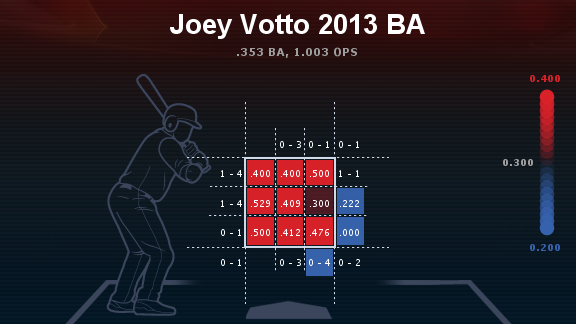
The Cincinnati Reds are the hottest team in the Majors right now. After going 8-2 over their last games, they trail the St. Louis Cardinals by a game and a half for the best record in all of baseball. Canadian Joey Votto has picked up right where he left off last season, and the 3-time all-star is continuing to stake his claim as one of the league’s premier first basemen. Last week, Votto took home NL Player of the Week honours, going 14-24 at the plate (.583), with 2 home runs, 5 RBIs and drawing 5 walks. This is what his heat chart looks like so far this season. Note to pitchers: Don’t throw strikes.

Easy on the ball Joey. Sheesh.

Easy on the ball Joey. Sheesh.

4. the pittsburgh penguinspenguins logo

Hey, hockey! Finally!

The Penguins haven’t been as dominant as most expected they’d be this post-season. After battling goaltending woes in their series with the Islanders (the polite way of saying Marc-Andre Fleury was hot garbage), the Pens have settled into some degree of normalcy on the back of 36-year old back-up goalie Tomas Vokoun. The former Nashville Predator & Florida Panther has amassed a .943 SV% so far this series, staking Pittsburgh to a 3-1 series lead over the Ottawa Senators. Despite the additions of Jarome Iginla, Douglas Murray and Brenden Morrow, the Vokoun free agent signing is looking more and more like GM Ray Shero’s best move of the season. They’re a double overtime, hardnosed, Colin Greening goal away from already having a spot in the Conference finals. It’s looking like it’s only a matter of time until they book their ticket.

5. the detroit red wingsDetroit-Red-Wings-Logo

For starters, I’m a big time Detroit fan, but I promise this ranking is completely justified. The Red Wings have gone 11-4 over their past 15 games, 11 of which have been played against teams seeded either 1st or 2nd in the Western Conference. Couple this with the 4 straight wins they strung together just to get into the playoffs and it’s plain to see that Coach Mike Babcock has his team heading in the right direction. Detroit has gotten contributions from everywhere, including a couple surprises. Not the least of which is Jakub Kindl, the former Kitchener Ranger who drew into the lineup after Danny DeKeyser broke his hand as was declared out for the remainder of the playoffs. Kindl scored the game-winning goal in last night’s 2-0 victory, and led the team with 5 shots. They’ve has also been spoiled with stellar goaltending from the underrated Jimmy Howard, who has stopped 86 of the last 88 shots he’s faced, and who has excelled to the tune of a .977 SV% over the past 3 games, all Detroit victories. Closing out the top-seeded Blackhawks will be a tough task though, as the likes of Patrick Kane, Jonathan Toews, Marian Hossa and Patty Sharp can take over a game at a moment’s notice.

honourable mention: the toronto blue jaysnew-blue-jays-logo

The Blue Jays are winning? Holy crap. It’s no secret that the team hasn’t lived up to the hype that surrounded their off-season moves, but if the past few games have been any indication, the team may be headed in the right direction. The Blue Jays are 7-3 over their last 10 games, making them the hottest team in the American League over that stretch. Not to mention that in those 7 wins, the Jays put up double-digit runs in 4 of them. Despite some pitching issues (Ricky Romero, R.A. Dickey’s back, Sergio Santos’ arm, Josh Johnson’s everything), the bullpen has been decent, and Casey Janssen has continued to flourish in the closer role. If the big bats of Edwin Encarnacion, Jose Bautista and J.P. Arencibia can stay hot, maybe this team can find it’s way back to .500 and beyond.

What’s in a street name?

Ever see a street sign and wonder how much, or how little thought went in to coming up with it?

These days, many subdivisions have themed names- The Village By The Arboretum for example, rolls through a series of tree-centric names from front to back. But then there’s the odd street like Hands Drive that makes you wonder what the story behind the name is. Surely there’s a story. I mean, there’s no way -short of tossing random nouns in a hat- that someone could just come up with that.

So, is that a consideration for you? Could you live on a street with a name that annoyed you?

Turns out that not only do the names of streets matter to people, but the street suffix has a marked impact on the sale price of homes too.

Trulia.com, an American real estate site took a look at over 2.5 million listings in their database and took the median PPSF (Price Per Square Foot) among prominent street suffixes. Here’s what they found (The percentages are each suffix’s share of the total number of properties analyzed):

  • Boulevard, 2%, $117.
  • Place, 2%, $110.
  • Road, 16%, $109.
  • Way, 3%, $107.
  • Terrace, 1%, $102.
  • Court, 6%, $101.
  • Lane, 8%, $101.
  • Circle, 3%, $100.
  • Trail, 1%, $97.
  • Avenue, 15%, $96.
  • Drive, 22%, $96.
  • Street, 19%, $86.
Streets like this contribute to the disparity.

Streets like this contribute to the disparity.

The biggest shocker here is undoubtedly the cost to live on the relatively generic “roads”. I don’t tend to equate “roads” with premium residential housing. To me, “terraces” and “courts” tend to suggest more luxurious accommodations, but what do I know?

Trulia was nice enough to offer some explanation for the pricing of homes on boulevards:

“Why is ‘boulevard’ the most expensive address suffix? Well, while the word does have a sophisticated French origin, it actually might have more to do with the mix of the homes located there. Approximately, 37% of homes on ‘boulevards’ are in multi-unit buildings, such as apartments and condos. In contrast, these types of homes make up no more than 16% of homes on every other address suffix. A greater concentration of multi-unit buildings could drive up costs as they are often located in denser, urban areas where space is at a premium.”

That city centre justification holds water for me. The smaller a home’s footprint, the greater PPSF you’ll end up paying, regardless of where it’s located. But especially when they’re located in urban centres, property in general will outpace that of the suburbs.

I’ve lived on a “drive”, a “street”, a “crescent” (which apparently isn’t as popular in the States as it is here), an “avenue” and a “road”. And while the “avenue” was the nicest by far, I can understand why the “street” is worth significantly less than all the others.

It was a far busier street than any of the others, and the house was dated. How dated you ask? We had a milk box. Exactly. A mail box but for milk, so when Ol’ Johnny came whistling along in his half-sized Purolator truck, he could set you up with a fresh supply of 2%.

The perception of street suffixes is a worthwhile consideration when buying a home, but ultimately, this study is better taken at face value. Nobody is going around writing off homes on XYZ Street based on a suffix. Either a house is on a busy street, in an urban core, with mature trees, or it isn’t. Still, this study reveals some pretty neat data on what street names tend to suggest.

Where do we put the students?

Student housing to parents.

Student housing to parents.

I use the term “we” very loosely as not 12 months ago, I was one of these “students” (read: messy, loud, rude vermin). And even though the debate raged in the media throughout my 4-year tenure at the University of Guelph, nobody seemed to put forward any concrete suggestions as to how to appease the student population or the long-term residents of various neighbourhoods.

Student housing to neighbours.

Student housing to neighbours.

Living in the Westminster Woods neighbourhood at the south-end, I was lucky enough that my neighbours had no ill-will towards myself or my roommates, at least that we were aware of. We were clean, respectful and -save for special occasions- dead quiet. Take a survey though, and you’d get the impression that we were in the heavy minority.

University towns like Guelph, Kingston and Waterloo are inevitably going to have a large rental population in the surrounding neighbourhoods. Given that most students operate on tight budgets and thus don’t rely on a car, this student distribution is heavily centred within the immediate vicinity of the school or along bus corridors. So, if you live close to a school, chances are, you’ll have students living on your street: it’s Urban Economics 101.

Rather than turn the Mayfield Park area, or the Gordon St. Corridor into the second coming of Queen’s student ghetto, we have to look at some progressive alternatives to the currently dysfunctional student-resident relationship. Personally, my experiences with the student-resident dynamic have been quite positive. But that doesn’t mean other students and owners haven’t gotten into it over things like taunting a goose with a ball. It seems like there can’t be pleasing everyone until they’re separated like toddlers on a timeout.

So how do we separate them? Where do the students go?

The ever-popular student destination in Guelph is Edinburgh Village. A world all its own, Edinburgh Village is home to only students and is isolated by a major road, forest, farmland and a plaza in each direction. They do really well at filling their sizeable development with students year-after-year. And not only do they fill it, they charge above-market rents to the tune of $550 per room, per month. Plus utilities. How? Location, location… you’ve heard it a million times. A short jaunt along a weather beaten “cow path” and you’d find yourself at the University in a matter of minutes.

So, if students will pay this much to live in an apartment, with a residence atmosphere and paper walls; is it so shocking that they’d flock to Mayfield Park and Old University which are both equally proximate, quieter, more spacious and the same price or cheaper?

No. At least not to me. I don’t think it would be to you either. It’s not exactly rocket scientist (-Deena, Jersey Shore). Sorry.

A rendering of Abode's proposal

A rendering of Abode’s proposal

Well then, along comes Abode Varsity Living to a chorus of boos from residents. Wait, what? They’re going to build a place to put the students that live among you and it’s not welcome? NIMBYism at its finest.

“We don’t want students living on our street, can’t you put them somewhere like a residence?”

“NO! Don’t build that residence THERE!”

And this is why real estate development is a pain-staking, drawn out process. It’s been 2 and half years since Abode submitted their proposal to the City of Guelph to re-zone and re-develop the lands currently housing a Best Western hotel and conference centre spot on the corner of Gordon St. & Stone Road, the gateway to Mayfield Park. Save for the scale of the project, I don’t understand why this isn’t a great location for a ton of students. Guelph has a floundering tourism industry, which, for all this city has, isn’t one of its finest efforts. So why not make better use of the property which has already served as a satellite residence for first-year students at peak times?

Well, suffice to say that the OMB (Ontario Municipal Board) ruled very much in favour in Abode’s proposal, despite the objections of both the City of Guelph and the Mayfield Park Residents’ Association, who was also party to the decision and fully armed with counsel and precendent. It just makes sense. If you want the students to “go away”, you need somewhere to put them. And since they are paying for it themselves, you’re going to have to make it somewhere they want to go.

So, we end up with a high-density, student-centric development closer to moving ahead; and at the cost of only a few years’ time, thousands and thousands of dollars & boatloads of grief for everyone. All to save a couple units and maybe a floor or two.  Was it worth it? For Abode, certainly. For the city, and Mayfield Park? It’ll depend on what the final design looks like, but I’m leaning towards a solid no on this one.

Barrier Reef Getaway- just a cool £75 Million

Do you have $150 million burning a hole in your pocket? Those low interest rates probably aren’t doing you any favours, so why not invest it in a chunk of the Great Barrier Reef?

Daydream Island, off the coast of Queensland, Australia is up for sale for the first time since 2000; as the current owner is planning on cashing out and retiring. £75 million should probably last him a few years…

What to get the billionaire who has everything: Tropical island on the Great Barrier Reef goes on sale for £75million -Daily Mail

  • Daydream Island off the coast of Queensland in Australia hosts 300-room luxury hotel with attached spa
  • Getaway offers snorkelling, jet-skiing and miles of lush golden beaches as well as world’s largest man-made reef

Record: The island boasts the world's largest man-made coral lagoon enabling guests to get up close and personal with tropical fish

The perfect gift for the billionaire who has everything has just come on the market – an idyllic tropical island tucked away in the Great Barrier Reef.

However, the Australian island is far from being a deserted getaway, as it hosts a 300-room luxury hotel and spa.

Daydream Island in Queensland, near the Whitsunday Islands, has doubtless shot to the top of the shopping list for the mega-rich after going up for sale for £75million.

The 4km-long island is covered in lush rainforest, and features the world’s largest man-made coral reef lagoon.

Its hotel boasts a private golden beach for each guest, and the outdoor aquarium features 50 different corals and 80 types of sea life.

Moguls who are keen to enjoy snorkelling, jet-skiing, scuba diving and other aquatic activities will be keen to stake their claim to be the new owner of Daydream Island.

Paradise: Arriving visitors are greeted by an array of palm trees by the jetty as they first reach Daydream Island

Flamboyant businessman Vaughan Bullivant snapped up the island in 2000, and is now hoping to hand it on to another entrepreneur after his retirement.

‘But I’m 65 now and looking to at some stage put my feet up and enjoy doing other things in life including more travel and spending time with my family, which has long been my goal,’ he said.

‘I intend to make sure that Daydream remains an industry leader and am looking for a suitable operator to take Daydream Island forward.’

Resort boss Phil Casey said that the island had never looked better, and claimed that its natural beauty had helped it thrive throughout the recession.

‘Daydream Island has just completed a very positive 12 months of trading which is extremely pleasing considering the tourism industry has had a very difficult time in recent years,’ he said.

‘The island’s management has worked hard to position Daydream as an Australian holiday destination of choice.

‘Visitors are voting with their feet and giving fabulous feedback about our beautiful island and the great times they are having there.’

He insisted the resort would not be sold to just anyone, and said he was confident the island would find a proprietor who is a good fit for the beautiful getaway.