
Want to Sell High? Get Inside Buyers’ Heads.

It’s no secret in real estate that, ultimately, price trumps all else. Every home will sell in a certain amount of time, at any given list price. Want to sell that mansion in Puslinch in twenty minutes? List it for $50,000. Don’t know why your 900 sq. ft. bungalow on Speedvale hasn’t sold in 9 years? It might be because you’re asking $750,000.

Extreme examples, sure. But it illustrates the point that the asking price, relative to the buyers’ perceived value of the house can have a profound impact on the time it takes to sell. When the list price exceeds perceived value, the house will sit on the market longer. If buyers see more value than the numerical value a seller puts on it, well then that’s where we see property move quickly.

The goal then, from a Realtor’s point of view is to strike the perfect harmony between a buyer’s willingness to pay and the sellers’ expectations and needs in terms of sale proceeds. Only in the rarest of circumstances, especially today, can a listing agent dupe buyers into paying more for a house than it’s worth. And sellers can be nieve in thinking otherwise. Just because, as a seller, you “need” a certain number for the house doesn’t mean there’s a single human on the planet who will give you that figure. Not to mention that today’s buyers are savvier than ever and shop loaded with information including: sale prices, days on market statistics, fact sheets on comparable properties and all sorts of other goodies readily accessible through a Realtor. The market, as a whole, doesn’t make mistakes.

Now that’s not to say that some sucker won’t. I’ve seen it before and I’ll see it a million more times where someone bought a house privately (*slams head into desk*), or on bad advice, and wound up paying way too much. But Buyer Representation Agreements, BRA’s for short, create a responsibility for agents to protect their buyer clients’ interests, and that includes not allowing them to overpay substantially without interjection & consultation. This means that as soon as a buyer locks in with their agent, your chance of taking them to the cleaners as a seller is virtually nil.

So, then, how do we manage to differenitate good agents from bad ones & smart sellers from suckers? A lot of it can boil down to the psychology behind a list price. The difference between a good deal & a bad deal is growing ever slimmer and outliers becoming more and more rare; but research has gone into strategizing a list price, and here’s what it says: The “just below” pricing model you see on listings every day generates greater sale prices than other pricing strategies.

For the same reason McDonald’s charges $4.99 for a Big Mac, and everything at Wal-Mart costs $X.96; selling your home for just less than a given number can make all the difference.

In fact, evidence from a December Washington Post article suggests that this charm pricing strategy -to make the house look more affordable- can actually result in a seller receiving 2% more on average than homes using a different strategy. And while 2% might not sound like much, consider that most buyer or “co-operating” agents earn a 2-2.5% commission for representing the buyer. In essence, with this strategy, you can have a buyer brought to your door for free.

There were more than a few highlights to the story, which I’d highly recommend reading in full at the source. That said, in an effort to summarize both the article & my thoughts:

1. Ignore the urge to meet search criteria. In a very aware move, the researchers asked buyers for their take on homes priced at a dead-even number such as $300,000. In theory, with so many buyers using auto-search criteria & Realtor.ca price ranges, evenly priced houses might show up in a few more searches than their unevenly priced counterparts. At $300k for example, you might show up in searches from $250k-$300k & $300k-$325k; a perceived benefit. In reality, feedback from buyers suggested that they felt sellers were just ballparking their asking prices and weren’t sure what it was really worth. On the other hand, a $299,900 list price looked like a bargain.
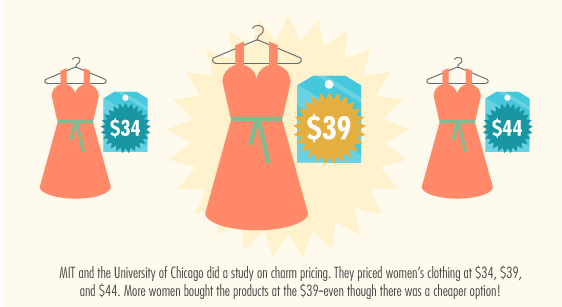
Charm Pricing

Source: Econsultancy/Arie Shpanya, 2014

2. Charm pricing promotes over-pricing. Just like in “The Goods” starring Jeremy Piven (an unjustly underrated movie, FWIW), the product doesn’t need to be a good deal- it just needs to look like it is. List prices designed to feel like a bargain didn’t end up being one for buyers. In fact, they were more overpriced than employers of any other pricing strategy… to the tune of about 5% each time. In the movie, Piven’s character, Don Ready, employs the classic “put a higher price sticker on the windshield, just to tear it off and close the guy with a bargain” move that car salesmen are known for. Home sellers do it too, whether they know they are or not.

3. There’s a method to the madness. Only 45% of listings took the charm pricing approach; with others deviating to the round-number pricing to fit search criteria, or an exact price (ie. $239,588, as if to suggest they just added up a bunch of receipts and this is their number). I can appreciate the merits of the round number pricing as more buyers turn to rigid search criteria online, however, only houses worth near to a major round number would even qualify for this strategy. Charm pricing appears in nearly every segment of our lives as buyers, from groceries to cars to shoes (as if to suggest women look at the prices of shoes), and there’s a reason for it. It works. It generates sales, while blissfully pulling the wool over buyers’ eyes. And as sellers, there’s nothing more you could ask for.



House price relief coming for first-timers?

reduced priceIs there a light at the end of the tunnel for first-time buyers? In spite of the first calls for price declines, lower prices may not mean an easier buy.

In a recent report, Robert Hogue, an economist for Royal Bank, sparked some interest by claiming that he expected interest rates to rise enough over the balance of 2014 & through 2015 to incite a drop in the sales prices of homes in 2016. That price drop would come on the heels of slower than average price growth through 2015 as well, which he estimates could be somewhere around 1.1%. The article here is worth a read for some perspective:

RBC economist predicts home price declines in 2016 as rates rise

Tara Perkins, Globe and Mail, August 20th 2014.

An economist at Canada’s biggest bank says home prices could start falling in 2016 if interest rates return to more normal levels. And he warned that, in the meantime, what goes up will likely come down if salaries and incomes don’t keep pace.

“The higher home prices get relative to income by the time rising interest rates really start to bite, the more prices will have to adjust (downwardly) over time to keep longer-term affordability from reaching intolerable levels,” Royal Bank of Canada economist Robert Hogue wrote in a research note Wednesday. “This means that any price increases exceeding the rate of household income gains in the near term (2014 and 2015) likely would result in steeper price declines down the road.”

Mr. Hogue is now expecting sales to tick down by almost 1 per cent next year, and home prices to rise by just 1.1 per cent (he is expecting prices to rise 4.3 per cent this year). That’s actually a stronger forecast than he released just two months ago, because low mortgage rates have been giving the housing market more fuel than expected. He’s now cautioning that too much momentum could be a bad thing for the market long term.

He believes that the current low level of interest rates is not sustainable, and that longer-term rates could rise meaningfully by late 2015 (RBC expects five-year Government of Canada bond yields to more than double to 3.30 per cent by the end of 2015. Five-year fixed mortgage rates tend to move in step with five-year government bond yields).

Rising interest rates will erode housing affordability, which Mr. Hogue notes is already stretched in some markets. “We expect the current upward momentum in home prices to wane gradually, as demand cools and more home sellers emerge,” he wrote. “We expect that the current condo construction boom in large urban centres will bring more properties on the resale market as units are completed. While the majority of condo units under construction are already sold, rapid increase in the stock of existing condos is likely to create a displacement effect whereby older units are vacated in favour of newer ones.”

Looking across the country, he expects a decline in the number of homes sold next year everywhere except in Atlantic Canada and Alberta. “High-priced British Columbia (mainly Vancouver) and Ontario (mainly Toronto) markets are projected to see the bigger drops (2.3 and 1.3 per cent, respectively), reflecting a more extensive erosion of affordability,” he wrote. “We forecast the resale declines in the other provinces to be modest to marginal.”

As for prices, he is forecasting a significant slowdown in the rate of growth next year everywhere except across Atlantic Canada, with Quebec likely to see a small decline in prices.

“Prices in B.C. and Ontario are forecasted to show greater moderation since this is where these negative pressures will be more intense,” he wrote. “Alberta remains at the top of our rankings for next year thanks to its strong economy and in-migration keeping the demand-supply equation still somewhat tight. We expect prices in Atlantic Canada to continue to track a slight upward trajectory.”

A number of signs have pointed to an inevitable decline in housing prices, particularly when it comes to the affordability indexes of housing relative to other necessary expenses. Salaries simply aren’t growing at the rate of housing prices, an issue that has been present since the beginning of the 21st century, if not sooner. It’s safe to say that, at least relatively speaking, we’re approaching the ceiling in terms of how much Canadians can spend on their abodes.

As noted above, Hogue expects Toronto to be among the hardest hit regions, although I don’t necessarily share that sentiment myself. While I understand that it’s among the most expensive real estate markets in the world in some clusters, I would expect that some buyers may turn to less expensive properties and create a bulge in the middle of the price spectrum (There are places in Toronto for less than $100k).

In my opinion, there are ample buyers in the Toronto single-detached market to sustain the current levels of sales activity. If there is a decline, it makes the most sense to me that the pre-construction condo market would be the first to go. I could understand sales being hampered by an unwillingness to tie-up deposits with slower price growth, speculation of price retractions, and more profitable options for those monies. This in turn though could have the opposite effect on the pricing of resale condominiums.

In terms of the effects on first-time buyers, there are divergent effects; the ultimate weight of which remains to be seen. On one hand, the increased rates, should they force downward price pressure, could result in lower sales prices as Hogue speculates. At the same time, first-timers will be facing a higher cost of borrowing, which could be detrimental for those attempting to buy with smaller down payments.

The luxury that first-time buyers have is time. It’s not worth waiting for prices to drop to make a first purchase. Even with a lower purchase price; unless you’re buying with cash, the net effect will be marginal. Keep in mind that there are going to be many fluctuations of the housing market over your 50 or so years of home ownership; and the housing market has traditionally done very well at weathering the storms. Whether you’re buying now or later, the net effect of 2-year price decline over 50 years is going to be negligible over the long-term. Consider too that when selling, chances are you’re concurrently buying as well -which means that even if you’re selling at a low point, you’re probably getting the same discount on the house you buy. It all works out in the end.


First-Time Buyers: Mortgages, Part One

Yeah. Part One.

Mortgages are quite the animal, so there’s a lot to know before you dive right into one. They’re also not super exciting, so it’s probably for the best that we split it up. We don’t need anyone giving up 2000 words in when we touch on collateral for the 8th time.

I figure we’re best to start with how to determine what we’ll qualify for, and then get into manipulating & expanding that number if your budget doesn’t suit your must-have list in Part Two.

8342940With real estate prices climbing ever higher, seemingly across the board, the Conservative government under Finance Minister Jim Flaherty made an array of changes to artificially cool the housing demand in 2012, reducing the risk of a bubble and simultaneous crash as seen south of the border. Despite it being against traditional Conservative financial policy to tamper with free markets, the government implements these new measures and made home ownership more difficult for first-time buyers and others alike.

The argument, naturally, is that the consumers affected by these changes likely shouldn’t have been buying properties anyway, since their situations were associated with higher risks of defaults and foreclosures. Personally, I feel these situations are better assessed on a person-to-person basis in terms of who can adapt their situations and survive rate hikes or reductions in income. At the same time, you have to respect the government applying the same rules to everyone, though it hurts people who otherwise could’ve managed.

In determining how much you can afford to spend on a home, lenders typically focus on two main ratios. Gross Debt Service, or the amount of the liabilities tied to your home, is currently capped at 39%. This means that the amount of your proposed mortgage payments plus your condo fees (if applicable), property taxes, and utilities should not exceed 39% of your household income. Total Debt Service, the more critical number, is also capped at 44%.This includes the aforementioned GDS components, but also any other personal liabilities you may have. Student loans, credit card debts, lines of credit and car loan payments are the most common additional charges in the TDS calculation. Typically a lender will look for these ratios to be at 32% at 40% respectively, which can be increased to the maximum based on high credit scores. We’ll address those in part two.

A major reason I feel the Flaherty changes were unnecessary is due to the little known benchmark, or qualifying rate. If you’ve never bought a home before, chances are you’ve never heard of this number, the one that likes to deflate expectations for new mortgagors. Here’s a tip: If you’re looking into properties to purchase and you use the mortgage calculator on a website/app like Realtor.ca, use the benchmark interest rate to qualify yourself, as that’s what your lender will be forced to use as well. Even though your ratios may be strong at an interest rate of 2.5% on a 5 year variable rate mortgage, you’ll have to have favourable GDS & TDS ratios based on the higher rate. The benchmark rate, which is the 5-year term fixed posted rate (currently 5.34%) is in place to protect against rate hikes, effectively the same thing Flaherty’s changes were put in place to do.

Once you’ve established what you believe you can afford, the process of choosing your actual mortgage begins. Comparison shopping is essential, and one of the best ways to do this is through a mortgage broker. Ben Melick of Mortgage Intelligence (Kitchener-Waterloo), Randy von Heyking of Mortgage Alliance and Rob Campbell of the Mortgage Wellness Group (Guelph) are all stand-up options for you to consult. It’s not even a bad idea to consult with one before you try and figure out what you can afford. They’ll help you through it. Mortgage brokers understand each product available and can point you in the direction of the product that’s right for you. If you already do all your banking and investing with the same major bank, they could also be a good option for you, since that can typically give you some leverage either for mortgages or other services. They’re not always the lowest rates, in fact they’re usually not, but at least you can be comfortable in having a one-stop shop for your finances and they can easily be managed all at once. That said, if you’re indifferent between loyalties to a bank and trying a mortgage broker, watch this CBC Marketplace episode (Segment 2, about 5 minutes) on big bank mortgages and go from there. It should help you make up your mind.

In Part Two we’ll look at credit scores: how they’re calculated, their impact and how to improve them; various types of incomes and how lenders view them; co-signers, which more and more of us have; mortgage insurance and high-ratio premiums vs. low-ratio mortgages. Let’s be honest though, mortgage posts can only be so long.

4 Condo Buying Questions You Should Know the Answer To

Dusk 109oz Rendering.jpgLet’s start with the obvious: Buying a condo has a number of key differences from buying a freehold detached home. As with any major purchase, it’s certainly important to do your research before jumping into anything with both feet. Being ill-prepared can lead to costly mistakes, especially when our home is the biggest investment most of us ever make.

Below is a list of important questions to ask prior to buying into a condo development:

What is a condo?

Let’s start from the beginning on this one. The word “condo” often gets associated with either a towering residential building with a hundred-plus units, or a beachside villa. Great as both may be, “condo” -or condominium, if you want to sound refined/bore people- actually refers to the type of ownership you’re buying into, not the building itself. Condos can even include townhouse complexes or entire communities.

Not only do you own your own “unit” within a complex, you also own a proportionate share of the common areas. In a building, this can include the elevators, hallways, amenities, etc., as well as the exterior land (parking lot, greenspace, landscaping). As a buyer, you become responsible for the maintenance of your unit, but also for common areas, often by way of paying common expenses or condo fees to the condo corporation or a property management company.

What do condo fees include?

condofeesIn every condo, there are costs beyond your monthly mortgage payment and property taxes that you must consider. Both the amount and components of a condo fee can vary greatly, depending on where you buy. One of the biggest considerations to make is the types of amenities you desire. A condo with high-end amenity spaces (lobby, theatre, etc.) will naturally have higher condo fees than a building which doesn’t have any amenities of note. Two of the biggest drivers of condo fees are concierge service and pools. While they’re nice to have, consider how often you will use a pool in your building, and make sure the additional expense is justifiable.

The age of a building can also increase the condo fees. While it may seem counter-intuitive to pay more to own an older unit, an older building requires greater maintenance expenses. Also, look over the financials and see the accumulation of the condo’s reserve fund. A reserve fund covers major expenses like a new roof or the re-finishing of a parking lot. Without a strong reserve fund, you could be on the hook for an unforeseen rise in your condo fees, should either of those need replacing. I’ve seen condos with locked up pools and hot tubs because jets or filtration systems have broken, there was no money in the reserve for them, and the residents that didn’t use them refused a special assessment to pay for it.

On top of maintenance and amenity costs, and reserve fund contributions, some condos will have utility charges bundled into the condo fees as well. This makes for a huge difference, especially if one $300 condo fee includes heating, cooling and water; and another one doesn’t.

Bottom line, find out what is included in your condo fees, and what you’ll have to pay on top. It’ll save you a lot of hassle down the road.

Will I be subjected to any rules or regulations?

The simple answer here is: “Probably, yes”. The number and flexibility of the rules varies from condo to condo, but there will likely be some degree of control put in place. Some of the most common rules surround:

Unit appearance (door/hallway decorations, window coverings, balcony contents)

Pets (size, number, noise)

Access (number of visitors, guest parking)

Noise (party limitations, quiet hours, amenity room closings)

It’s important that you find a condo that suits your lifestyle. After all, it’s a major key to enjoying your new living arrangement. There’s nothing worse than feeling restricted within your home, so make sure that the rules are conducive to the way you live.

What’s a better purchase, a new condominium or a re-sale?

At the risk of being blatantly non-committal, it’s hard to say whether one choice is better than another.

If you’re looking at a new build, there’s usually a cost benefit to buying pre-construction. Builders will offer lower prices earlier in the process and some buyers will flip the condos upon completion for a profit. If you buy pre-construction as well, you’re open to a greater selection variety. Not only can you choose the floor and location of your suite in the building, but you can also select the interior finishes such as flooring, cabinetry and countertops. The new building is also protected by the Tarion New Home Warranty program and condo fees are usually lowest at the birth of a new building due to the lack of depreciation and wear on structures & systems.

On the other hand, there are a number of advantages to buying a condo unit that has already been completed, whether new or previously lived in. For one, your occupancy or closing date will be fixed. In a new build, the builder can delay occupancy given adequate notice and building registration can require a certain number of occupied units before the purchase actually closes. Until the building is registered, buyers who live in the building pay an occupancy fee which basically equates to rent until the mortgage can be applied to the deeded unit. Deposits held in trust for a resale are often much lower than the required deposits in a pre-construction project. Not to be confused with a down payment, the deposit a builder requires can vary from about $20,000 to 20% depending on each builder’s unique structure. On a resale, a $5k deposit will usually suffice until closing. Older buildings often have larger unit sizes, and you can actually tour the suite prior to buying. More and more builders are creating model suites or vignettes; but resales allow you to experience the actual unit, its colours, sizes and views prior to pulling trigger on a purchase.

Whether you buy a new or re-sale condo, here are a few personal tips:

1. Builders always have a target market in mind. Get a feel for what that market is, so you live in an atmosphere wherein you’re completely compatible. If you’re a 20-something, a trendy downtown condo may be more suitable than a suburban tower with amenities geared to older buyers.

2. Spend some time in the unit, especially if it’s your first condo. Moving can be pricey, you want to make sure you get it right the first time. And a condo can be more of an adjustment for some than others. Take a coffee and a book, sit there and see if you can picture yourself spending time in your new home. If not, then maybe that unit’s not quite right for you.

3. Look at a few condos. Especially with new developments, the first impressions are great. Everything is clean and new. But that fades, so make sure the meat and potatoes of the unit is to your liking as well. By comparing multiple buildings and becoming a more educated buyer, you certainly decrease your chances of buyers remorse.

4. Act quickly with new developments. Not to contradict my previous point, but if you really like a unit, chances are someone else will too. Odds are, you can get a few of those units in the building, but not necessarily with the same view or options. Once you’ve decided that a condo is right for you, try and see a few in a short time. It makes it easier to compare and feel comfortable in that decision. New developments here allow a 10-day “cooling-off” period wherein you can change your mind and back out of a deal without penalty. Prices of new developments don’t go down after the launch, they only go up. And after all, you’d hate to miss out on that perfect unit.

First-Time Buyers: Negotiating Your First Purchase

Negotiating a First Home PurchaseStellar, you’ve found the place for you. Maybe it’s home for 3 years, maybe for 10; but after all the searching on Realtor.ca, open houses, newspapers, private showings, you know this is the one you want. Now the question becomes, how do you lock it up and make it yours?

There two big factors in a first-time buyer’s favour when it comes to negotiating a deal on that perfect place. The first is flexibility, the second: cash.

I don’t mean cash as if the world is full of loaded 20-somethings, but rather that the math is all done and the money is there. You’ve been pre-qualified for a mortgage, you don’t have a house to sell and it’s just a matter of pulling the trigger. Many buyers who already own a home aren’t willing to sign an agreement on a new place until they have some assurance that they won’t be burdened with a pair of mortgages for an extended period of time. This means any first-timer’s offer at a similar price-point is more lucrative than one conditional on the buyer selling their current place. The less the seller needs to wait for and worry about, the better, and usually they’d be willing to sacrifice a few thousand dollars for a firm deal.

First-timers are also a pretty flexible bunch. Without kids in the picture, there’s less consideration for the timing of the move, which tend to occur most often when kids are on summer holidays. With a lease, or living at Mom and Dad’s, you can be flexible with your closing date to suit the sellers’ needs. If the sellers want to close in 2 weeks and all you have to do is lug your futon out of your parents’ basement, there’s nothing stopping you from doing it, and that’s rare.

The same flexibility that lets you choose your move in date can also give you the freedom to walk away from a bad deal. Use that to your advantage. If you’re shopping for a townhouse or in a newer subdivision, it’s easy to find the same floor plan for sale nearby. Don’t feel it necessary to overpay for a home that there are an abundance of, especially if you can afford to wait for another similar one to pop up.

There are other factors that can impact your strategy in negotiations- one of which is multiple representation. When an agent represents both the seller and you (as a buyer), they are bound in terms of what they can disclose about the other side. Essentially, calling the listing agent to see a property will put you in this situation every time; and it effectively removes the agent from the negotiating and turns them into a mere paper mule. Multiple representation limits the advising and strategy-planning role of the agent. Not only are listing agents constrained in consulting you as a first-time negotiator, they have an added motivation to put you in the house they’re selling. As a result, you’re better served as a buyer using an agent who will shop different houses with you- establishing a strong understanding of each other and strengthening trust along the process. That way, when you do settle on the right place, they know your needs, motivations and budget and also how to best negotiate on your behalf, representing you alone.

A good offer price is always subjective. Even though 2 agents on either side of the negotiation both likely know what the home is worth, they are only 2 of the 4 players in the game. Sellers may require a certain sale price to validate their move, and buyers often work within set budgets, so houses don’t always sell for their true “value”. Offering on a house differs given a number of factors including buyer & seller motivation, the length of time the house has been on the market, market value, the number of other interested parties, etc. Obviously you can offer lower on a home with a motivated seller whose house has been on the market for 3 months with no action than you should on a property that just hit the market and is likely to garner multiple offers. Situational awareness is key, and a good Realtor will know the signs to look for to get you the best deal.

Strong negotiating is an acquired skill. You don’t want to learn that the hard way on your first home purchase. Consider expert advice and put yourself in the best situation to make an informed decision, whether it be on your own or with an ally such as a Realtor on your side. It won’t cost you anything, so bringing in an agent to work for you is common sense. Failing to do you homework can lead to you not enjoying your first home for all it should be. Just remember, you only get one chance to buy your first house.

First-Time Buyers: Down Payments

Soon-to-be first-time buyer? Well, that’s me. And based on this blog’s readership, there’s an 80% chance that’s you too.

It’s a grind. Believe me. If you’ve looked into buying your first house, you understand the weight of your decision (hopefully); and if not, you’ll realize when you look for the first time. As many of us battle along, whether under the ominous cloud of a student loan or the pain-staking job search in a slowly recovering market, it’s important to keep our goals in mind. The pressures of the current day-to-day can detract from our ability to see our endgame.

For many of us, that next big goal is home ownership. It’s an ever-evolving need, but a strong investment in our futures at the same time. It’s a shelter for our earnings, a store of value, a forced savings, and our greatest chance to build equity in ourselves. The type of home and where it’s located can vary for us over the years, but the equity we build up in it will follow us throughout our lives.

So how do we start? Well, man, that’s a tough one. It’s hard to say, given that we’re all unique in our situations. Some of us have jobs, but tens of thousands in student loans. Some of us don’t have the loans, but can’t find that job that’ll take us to the next level. And for the select few that have managed to string it all together so far, congrats.

The hardest part is saving for the down payment, I think everyone can agree on that. Buying a home on budget is pretty easy, and you can adjust your price range accordingly. It’s coming up with that extra chunk of money that gets in the way for a lot of people. In a recent TD survey, up to 60 percent of first-time buyers weren’t satisfied with the size of their down payments. Not only does a larger down payment make for smaller mortgage payments, it reduces the amount of mortgage insurance you’re liable for, plus it makes refinancing easier when the time comes. This is an interesting catch-22. On one hand, most folks would rather own a home sooner and stop paying someone else’s mortgage. But at the same time, a smaller down payment is a handicap of sorts, and makes the budget that much tighter on a monthly basis. The trade-offs are never crystal clear.

There’s no magic number for a down payment, but there are 2 key thresholds: 5% and 20%. 5% is the absolute minimum down payment you’ll need to make on your home, and 20%, the minimum amount required to avoid mandatory mortgage insurance. Breathe at 5, shoot for 20. And though it can seem like a bit of a daunting task at times, the majority of people don’t expect the extra savings to take too long. Once you establish the routine of saving, and get to a point where you can put extra cash aside, it only gets easier.

It’s like losing weight. Sure, it’s tough to start a new routine or regimen, but once you find your groove, it’s all gravy. Low-fat, tofu gravy.

So if you’re at the point where you think your first purchase is on the horizon, let’s have a chat. A real estate agent can help you set those goals and establish a budget. And who better to have on your side than friend, in the same boat, who’ll work for you for free? I’m here to help. Let’s get started.