
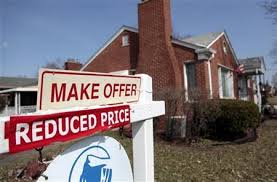
 Is there a light at the end of the tunnel for first-time buyers? In spite of the first calls for price declines, lower prices may not mean an easier buy.
In a recent report, Robert Hogue, an economist for Royal Bank, sparked some interest by claiming that he expected interest rates to rise enough over the balance of 2014 & through 2015 to incite a drop in the sales prices of homes in 2016. That price drop would come on the heels of slower than average price growth through 2015 as well, which he estimates could be somewhere around 1.1%. The article here is worth a read for some perspective:
RBC economist predicts home price declines in 2016 as rates rise
Tara Perkins, Globe and Mail, August 20th 2014.
An economist at Canada’s biggest bank says home prices could start falling in 2016 if interest rates return to more normal levels. And he warned that, in the meantime, what goes up will likely come down if salaries and incomes don’t keep pace.
“The higher home prices get relative to income by the time rising interest rates really start to bite, the more prices will have to adjust (downwardly) over time to keep longer-term affordability from reaching intolerable levels,” Royal Bank of Canada economist Robert Hogue wrote in a research note Wednesday. “This means that any price increases exceeding the rate of household income gains in the near term (2014 and 2015) likely would result in steeper price declines down the road.”
Mr. Hogue is now expecting sales to tick down by almost 1 per cent next year, and home prices to rise by just 1.1 per cent (he is expecting prices to rise 4.3 per cent this year). That’s actually a stronger forecast than he released just two months ago, because low mortgage rates have been giving the housing market more fuel than expected. He’s now cautioning that too much momentum could be a bad thing for the market long term.
He believes that the current low level of interest rates is not sustainable, and that longer-term rates could rise meaningfully by late 2015 (RBC expects five-year Government of Canada bond yields to more than double to 3.30 per cent by the end of 2015. Five-year fixed mortgage rates tend to move in step with five-year government bond yields).
Rising interest rates will erode housing affordability, which Mr. Hogue notes is already stretched in some markets. “We expect the current upward momentum in home prices to wane gradually, as demand cools and more home sellers emerge,” he wrote. “We expect that the current condo construction boom in large urban centres will bring more properties on the resale market as units are completed. While the majority of condo units under construction are already sold, rapid increase in the stock of existing condos is likely to create a displacement effect whereby older units are vacated in favour of newer ones.”
Looking across the country, he expects a decline in the number of homes sold next year everywhere except in Atlantic Canada and Alberta. “High-priced British Columbia (mainly Vancouver) and Ontario (mainly Toronto) markets are projected to see the bigger drops (2.3 and 1.3 per cent, respectively), reflecting a more extensive erosion of affordability,” he wrote. “We forecast the resale declines in the other provinces to be modest to marginal.”
As for prices, he is forecasting a significant slowdown in the rate of growth next year everywhere except across Atlantic Canada, with Quebec likely to see a small decline in prices.
“Prices in B.C. and Ontario are forecasted to show greater moderation since this is where these negative pressures will be more intense,” he wrote. “Alberta remains at the top of our rankings for next year thanks to its strong economy and in-migration keeping the demand-supply equation still somewhat tight. We expect prices in Atlantic Canada to continue to track a slight upward trajectory.”
A number of signs have pointed to an inevitable decline in housing prices, particularly when it comes to the affordability indexes of housing relative to other necessary expenses. Salaries simply aren’t growing at the rate of housing prices, an issue that has been present since the beginning of the 21st century, if not sooner. It’s safe to say that, at least relatively speaking, we’re approaching the ceiling in terms of how much Canadians can spend on their abodes.
As noted above, Hogue expects Toronto to be among the hardest hit regions, although I don’t necessarily share that sentiment myself. While I understand that it’s among the most expensive real estate markets in the world in some clusters, I would expect that some buyers may turn to less expensive properties and create a bulge in the middle of the price spectrum (There are places in Toronto for less than $100k).
In my opinion, there are ample buyers in the Toronto single-detached market to sustain the current levels of sales activity. If there is a decline, it makes the most sense to me that the pre-construction condo market would be the first to go. I could understand sales being hampered by an unwillingness to tie-up deposits with slower price growth, speculation of price retractions, and more profitable options for those monies. This in turn though could have the opposite effect on the pricing of resale condominiums.
In terms of the effects on first-time buyers, there are divergent effects; the ultimate weight of which remains to be seen. On one hand, the increased rates, should they force downward price pressure, could result in lower sales prices as Hogue speculates. At the same time, first-timers will be facing a higher cost of borrowing, which could be detrimental for those attempting to buy with smaller down payments.
The luxury that first-time buyers have is time. It’s not worth waiting for prices to drop to make a first purchase. Even with a lower purchase price; unless you’re buying with cash, the net effect will be marginal. Keep in mind that there are going to be many fluctuations of the housing market over your 50 or so years of home ownership; and the housing market has traditionally done very well at weathering the storms. Whether you’re buying now or later, the net effect of 2-year price decline over 50 years is going to be negligible over the long-term. Consider too that when selling, chances are you’re concurrently buying as well -which means that even if you’re selling at a low point, you’re probably getting the same discount on the house you buy. It all works out in the end.
 Real Estate Play-By-Play