
Want to Sell High? Get Inside Buyers’ Heads.

It’s no secret in real estate that, ultimately, price trumps all else. Every home will sell in a certain amount of time, at any given list price. Want to sell that mansion in Puslinch in twenty minutes? List it for $50,000. Don’t know why your 900 sq. ft. bungalow on Speedvale hasn’t sold in 9 years? It might be because you’re asking $750,000.

Extreme examples, sure. But it illustrates the point that the asking price, relative to the buyers’ perceived value of the house can have a profound impact on the time it takes to sell. When the list price exceeds perceived value, the house will sit on the market longer. If buyers see more value than the numerical value a seller puts on it, well then that’s where we see property move quickly.

The goal then, from a Realtor’s point of view is to strike the perfect harmony between a buyer’s willingness to pay and the sellers’ expectations and needs in terms of sale proceeds. Only in the rarest of circumstances, especially today, can a listing agent dupe buyers into paying more for a house than it’s worth. And sellers can be nieve in thinking otherwise. Just because, as a seller, you “need” a certain number for the house doesn’t mean there’s a single human on the planet who will give you that figure. Not to mention that today’s buyers are savvier than ever and shop loaded with information including: sale prices, days on market statistics, fact sheets on comparable properties and all sorts of other goodies readily accessible through a Realtor. The market, as a whole, doesn’t make mistakes.

Now that’s not to say that some sucker won’t. I’ve seen it before and I’ll see it a million more times where someone bought a house privately (*slams head into desk*), or on bad advice, and wound up paying way too much. But Buyer Representation Agreements, BRA’s for short, create a responsibility for agents to protect their buyer clients’ interests, and that includes not allowing them to overpay substantially without interjection & consultation. This means that as soon as a buyer locks in with their agent, your chance of taking them to the cleaners as a seller is virtually nil.

So, then, how do we manage to differenitate good agents from bad ones & smart sellers from suckers? A lot of it can boil down to the psychology behind a list price. The difference between a good deal & a bad deal is growing ever slimmer and outliers becoming more and more rare; but research has gone into strategizing a list price, and here’s what it says: The “just below” pricing model you see on listings every day generates greater sale prices than other pricing strategies.

For the same reason McDonald’s charges $4.99 for a Big Mac, and everything at Wal-Mart costs $X.96; selling your home for just less than a given number can make all the difference.

In fact, evidence from a December Washington Post article suggests that this charm pricing strategy -to make the house look more affordable- can actually result in a seller receiving 2% more on average than homes using a different strategy. And while 2% might not sound like much, consider that most buyer or “co-operating” agents earn a 2-2.5% commission for representing the buyer. In essence, with this strategy, you can have a buyer brought to your door for free.

There were more than a few highlights to the story, which I’d highly recommend reading in full at the source. That said, in an effort to summarize both the article & my thoughts:

1. Ignore the urge to meet search criteria. In a very aware move, the researchers asked buyers for their take on homes priced at a dead-even number such as $300,000. In theory, with so many buyers using auto-search criteria & Realtor.ca price ranges, evenly priced houses might show up in a few more searches than their unevenly priced counterparts. At $300k for example, you might show up in searches from $250k-$300k & $300k-$325k; a perceived benefit. In reality, feedback from buyers suggested that they felt sellers were just ballparking their asking prices and weren’t sure what it was really worth. On the other hand, a $299,900 list price looked like a bargain.
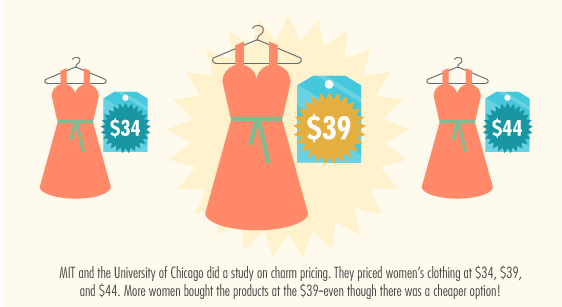
Charm Pricing

Source: Econsultancy/Arie Shpanya, 2014

2. Charm pricing promotes over-pricing. Just like in “The Goods” starring Jeremy Piven (an unjustly underrated movie, FWIW), the product doesn’t need to be a good deal- it just needs to look like it is. List prices designed to feel like a bargain didn’t end up being one for buyers. In fact, they were more overpriced than employers of any other pricing strategy… to the tune of about 5% each time. In the movie, Piven’s character, Don Ready, employs the classic “put a higher price sticker on the windshield, just to tear it off and close the guy with a bargain” move that car salesmen are known for. Home sellers do it too, whether they know they are or not.

3. There’s a method to the madness. Only 45% of listings took the charm pricing approach; with others deviating to the round-number pricing to fit search criteria, or an exact price (ie. $239,588, as if to suggest they just added up a bunch of receipts and this is their number). I can appreciate the merits of the round number pricing as more buyers turn to rigid search criteria online, however, only houses worth near to a major round number would even qualify for this strategy. Charm pricing appears in nearly every segment of our lives as buyers, from groceries to cars to shoes (as if to suggest women look at the prices of shoes), and there’s a reason for it. It works. It generates sales, while blissfully pulling the wool over buyers’ eyes. And as sellers, there’s nothing more you could ask for.




Upsize or upgrade? More Canadians choosing the latter.

Are you up for the challenge? Have you done your own home renos before?

Are you up for the challenge? Have you done your own home renos before?

Over the past year, Canadians (especially in major urban centres) have been driving the renovation industry past the new construction industry, as housing affordability dives ever-lower. The trend, seemingly brought on by faster price growth in larger homes, is a further sign of income inequality. The wealthy making more and the poor earning less. People unable to afford the space they desire in larger homes, are finding themselves forced to manufacture space- via remodeling, finishing a basement, or creating an addition.

Spending on renovations outpaces new home construction

By Tara Perkins, Globe & Mail

A rising proportion of homeowners find it impossible to trade up to higher-priced residences

More money was spent renovating homes in Canada than building new ones during the 12 months to the end of June, according to data compiled by the Bank of Montreal.

“In the four quarters through [the second quarter], renovation activity outpaced investment in new residential construction $48.4-billion to $46.3-billion, as the latter has rolled over recently,” BMO economist Robert Kavcic pointed out in a recent research note. “Indeed, while new construction spending was down in recent quarters, renovation spending accelerated to a 6.9 per cent year-over-year clip in Q2.”

That fits recent findings from Canadian Imperial Bank of Commerce economist Benjamin Tal. He noticed that prices of higher-priced homes are rising faster than prices of lower-priced homes in cities such as Toronto, Ottawa, Calgary and Edmonton. That’s making it harder for homeowners to trade up to a bigger or better home. “Regardless of what your starting point is, and by how much your property has appreciated, the desired move up target is getting further and further out of reach,” Mr. Tal wrote in a research note last month.

So homeowners are increasingly choosing to renovate. “Over the past five years, spending on home renovations as a share of total residential investment averaged close to 46 per cent – by far the largest share on record,” Mr. Tal wrote.

The increasing inability to trade up is not the only factor that economists foresee weighing on the number of homes changing hands. “An aging population – the proportion of Canadians aged 65 and over is expected to climb from 15 per cent in 2013 to 23 per cent by 2030 – will reduce housing turnover, and the volume of listings and sales transactions,” Bank of Nova Scotia economist Adrienne Warren wrote in a research note Thursday. “The likelihood of moving in any given year declines progressively with age. Between 2006 and 2011, only 11 per cent of homeowners aged 65 and over changed residences, compared with 34 per cent of all other homeowners.”

With a larger elderly population staying put in their homes, and a rising proportion of homeowners unable to trade up, demand for renovation work could stay strong.

Ms. Warren estimates that annual growth in the number of Canadian households should remain relatively high around 180,000 to the end of the decade, before gradually declining to around 150,000 by 2030.

“By 2020, the bulk of the relatively large baby echo generation will have formed independent households, while the share of the population 75 and over begins to climb more rapidly,” she wrote. “This level of household formation is consistent with a sustainable annual pace of housing starts, including replacement demand, of around 155,000 in 2030, down from around 185,000 today.”

But Ms. Warren added that even with the slowdown in household formation, Canada’s total housing stock (both rental units and those for owner-occupiers) will have to expand by more than 2.5 million units between now and 2030 to meet the needs of the population.

So, while renovations will likely remain strong, new home construction will still be a force in the economy.”

Naturally, in the local markets, land values haven’t increased to such elevated levels that the renovation industry is outpacing its construction counterparts; but this is certainly all a by-product of surging land prices. It’s a constant battle for space-efficient designs that isn’t going anywhere.

As interest rates begin to rise again, smaller debt loads will become more imperative for homeowners looking to balance their books. A line of credit, whether personal or from the equity they’ve built, allows them to carry a smaller balance than a new mortgage on a larger house, while also avoiding the mortgage penalties & other costs of moving. I would look for this trend to continue for some time, as homeowners finance the work instead of financing the move.

“I WANT TO BUY A CONDO…


Coletara's latest Guelph condo under construction- Ten77

Coletara’s latest Guelph condo under construction- Ten77

…But I don’t know what, how or why I should buy.”

For many first-time buyers (nearly all, if we’re talking about Toronto), downsizing seniors and empty nesters, condo living is a desirable option –if not far & away the best.

For those who have never owned a home, condo ownership is essentially Home Ownership Lite. Instead of doing all the maintenance and undertaking the personal expense of a freehold home, you pay into a communal pot that takes care of most of the upkeep you’d normally have to do yourself. This is especially great if you’ve always lived at home. It gives you the chance to learn things like how to make Kraft Dinner and how an iron works, without tying yourself up worrying about the expense of a leaky roof or how not to kill a garden full of hostas & geraniums.

If you’ve owned your home for many years, I don’t need to tell you how quickly the Honey-Do list becomes a multi-page pipe dream. Besides, now that the kids are gone, it’s time for Mom & Dad to forego the house work and head down to Mexico and the island barstools with your names on them. Condo living is the paramount option for those of us who just want to lock the door and take off for weeks or months at a time. Not to mention that the communal property maintenance doesn’t eat into your time on the golf course.

So, however your condo wish came to be, I’m here to help make it a reality. With over 150 condominium transactions’ worth of both new and resale experience, I know that whichever style of condo you’re looking for, I can get you into something that’s exactly what you’re looking for.

I’ve created a package, in which you’ll find some key forms to help you differentiate various condo options as well as a glossary for terms that you may have never encountered before. There are a number of things (ie. The reserve fund) that are not necessarily public knowledge or easily accessible. That’s where the value of a good Realtor and hard-working lawyer can be of tremendous service to you. All you have to do is ask and we’re happy to track down that information on any listing you might find on Realtor.ca, in a newspaper or just by driving around the area. Remember that as a buyer, you pay no commission, as it is the seller’s responsibility to pick up that tab. Use the professional help that’s there for the taking.

If you’re ready to get started, that’s fantastic. All you have to do is give me a call and we can work as a team to take it from there. I can’t wait to hear from you.