
How Young Homebuyers Are Bucking the “Too Expensive” Narrative

“Home ownership is too costly.”

“We don’t make enough money.”

“Banks are biased against us.”

Regardless of validity, the reasons against ownership for young people are numerous. Despite them however, more and more are defying the excuses and converting their hard-earned paycheques into a piece of property to call their own.
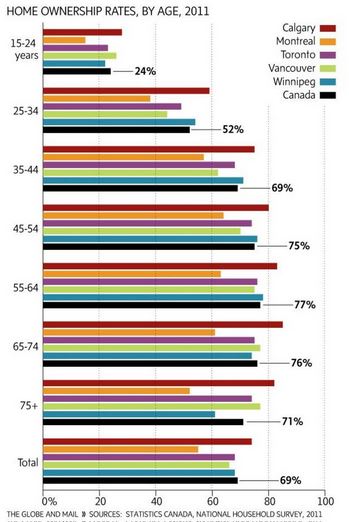
More and more young people are buying houses & condos, despite narratives to the contrary. From: The Globe & Mail

More and more young people are buying houses & condos, despite narratives to the contrary. From: The Globe & Mail

It’s a good thing they are too, as rates of home ownership tend to decline after age 65. While our demographics shift toward an older population, young buyers will be expected to fill that void. An inability to do so long-term could create a vast housing surplus, and drop property values across the board. So far though, it seems that the under-25 crowd are keeping things heading in the right direction.

Over the past decade and beyond, home values in some of the major urban cores have skyrocketed as land scarcity and foreign investment have pushed housing demand ever higher. It pits buyers of all kinds, especially young buyers with less accrued equity, in a tight spot. They’re being forced to compete with foreign, cash buyers using the Canadian real estate market as their own personal piggy bank, outside the grasp of their communist governments. Naturally, t’s a one-sided fight.

That said, in smaller markets, housing remains substantially more affordable; and the goal of home ownership much more attainable than the general overlying narrative. Furthermore, if buyers in Vancouver, Toronto and Montreal can buck the trend, then the same should be true across the board.

I hear people my age talk a lot about how expensive housing is, and what they don’t often consider is that there are landlords out there making positive cash flows off of them. In select instances, a landlord can lump mortgage costs, insurance and taxes together and still take his family out for a steak dinner on a tenant’s rent. So why then, aren’t young people more proactive about it?

Overall, we are finally catching on. In fact, home ownership among the youngest share of the population (Under 25’s) rose by 4% from 2006 to 2011 and now remains around 25% from the graphic above. To buyers’ benefits, price growth was minimally stunted by the US recession, aiding in affordability. However these gains come despite consistent upward price movement from the big 3 Canadian cities, and in ignorance of decreased affordability in those markets.

How is this possible?

Having established that, counter-intuitively, this generation’s ownership share’s been growing; it’s key to take a look at how. The biggest contributors are buyers’ parents, who are pitching in with down-payments more than ever before. From 2010-2014, first-time homebuyers received about 11% of down payments as gifts from family members, with another 6% coming from personal loans from family members. Though the loan share was unchanged from 2000-2004, the gifted portion is about 5% higher than 10 years ago. With average down payments equaling about 21% on first-time purchases, that 17% figure amounts to $10,080 on your average $300,000 home. For perspective, the house my grandparents bought in 1970 set them back a measly $10k to own it outright, so I guess $10,000 gifts are peanuts. It is understandable though that with the rise in values we’ve, the help from the folks is almost necessary to sustain the goals of today’s young shopper, and given that it’s been the parent’s houses who’ve seen the growth, we know the equity is there to be able to make these gifts, generally speaking.

As parents' aid pushes demand from D1 to D2, both the quantity demanded and the market price rise, furthering the handicap for those without family funding.

As parents’ aid pushes demand from D1 to D2, both the quantity demanded and the market price rise, furthering the handicap for those without family funding.

At the same time, parents are artificially fueling the fire. By adding $10,000 to the budgets of a growing market share, parents are effectively promoting the ballooning of home prices. As illustrated here, these gifts that young buyers are stumbling into is resulting in more buyers entering the market, and buyers’ budgets being greater than they might otherwise be. This in itself creates a bit of a dangerous predicament, since some buyers are being aided by their parents while others are not, and this price shift pushes the latter further from their ownership goals. The Canadian Association of Accredited Mortgage Professionals disputes the impact that parents are having on prices, but consider this: With 1/3 of 18- to 35-year olds who haven’t bought a home attributing the decision to waiting for prices to drop; how will they ever drop if parents keep pumping in money? Answer: They won’t. Even if you don’t have the help, use parents supporting the market as a way to make your house purchase work for you.

Housing is like any investment. You have to pay to play, and you’re not going to make a cent off of it unless you buy something. The people that complain certain stocks are too expensive are the ones who sat on the sideline didn’t buy in when they were affordable. There are elements of risk involved, but you can continue to pay rent to a landlord or you can cut out other expenses to make home ownership a reality. It’s a decision that more and more young people are making sacrifices to pursue. And I can’t blame them for a second.


With statistics from (Links in post):

“How young Vancouver buyers are crashing the real estate party”, Frances Bula, Globe and Mail, October 17, 2014.

“1st time home buyers get more family help for down payment”, CBC News, November 18, 2014.

Upsize or upgrade? More Canadians choosing the latter.

Are you up for the challenge? Have you done your own home renos before?

Are you up for the challenge? Have you done your own home renos before?

Over the past year, Canadians (especially in major urban centres) have been driving the renovation industry past the new construction industry, as housing affordability dives ever-lower. The trend, seemingly brought on by faster price growth in larger homes, is a further sign of income inequality. The wealthy making more and the poor earning less. People unable to afford the space they desire in larger homes, are finding themselves forced to manufacture space- via remodeling, finishing a basement, or creating an addition.

Spending on renovations outpaces new home construction

By Tara Perkins, Globe & Mail

A rising proportion of homeowners find it impossible to trade up to higher-priced residences

More money was spent renovating homes in Canada than building new ones during the 12 months to the end of June, according to data compiled by the Bank of Montreal.

“In the four quarters through [the second quarter], renovation activity outpaced investment in new residential construction $48.4-billion to $46.3-billion, as the latter has rolled over recently,” BMO economist Robert Kavcic pointed out in a recent research note. “Indeed, while new construction spending was down in recent quarters, renovation spending accelerated to a 6.9 per cent year-over-year clip in Q2.”

That fits recent findings from Canadian Imperial Bank of Commerce economist Benjamin Tal. He noticed that prices of higher-priced homes are rising faster than prices of lower-priced homes in cities such as Toronto, Ottawa, Calgary and Edmonton. That’s making it harder for homeowners to trade up to a bigger or better home. “Regardless of what your starting point is, and by how much your property has appreciated, the desired move up target is getting further and further out of reach,” Mr. Tal wrote in a research note last month.

So homeowners are increasingly choosing to renovate. “Over the past five years, spending on home renovations as a share of total residential investment averaged close to 46 per cent – by far the largest share on record,” Mr. Tal wrote.

The increasing inability to trade up is not the only factor that economists foresee weighing on the number of homes changing hands. “An aging population – the proportion of Canadians aged 65 and over is expected to climb from 15 per cent in 2013 to 23 per cent by 2030 – will reduce housing turnover, and the volume of listings and sales transactions,” Bank of Nova Scotia economist Adrienne Warren wrote in a research note Thursday. “The likelihood of moving in any given year declines progressively with age. Between 2006 and 2011, only 11 per cent of homeowners aged 65 and over changed residences, compared with 34 per cent of all other homeowners.”

With a larger elderly population staying put in their homes, and a rising proportion of homeowners unable to trade up, demand for renovation work could stay strong.

Ms. Warren estimates that annual growth in the number of Canadian households should remain relatively high around 180,000 to the end of the decade, before gradually declining to around 150,000 by 2030.

“By 2020, the bulk of the relatively large baby echo generation will have formed independent households, while the share of the population 75 and over begins to climb more rapidly,” she wrote. “This level of household formation is consistent with a sustainable annual pace of housing starts, including replacement demand, of around 155,000 in 2030, down from around 185,000 today.”

But Ms. Warren added that even with the slowdown in household formation, Canada’s total housing stock (both rental units and those for owner-occupiers) will have to expand by more than 2.5 million units between now and 2030 to meet the needs of the population.

So, while renovations will likely remain strong, new home construction will still be a force in the economy.”

Naturally, in the local markets, land values haven’t increased to such elevated levels that the renovation industry is outpacing its construction counterparts; but this is certainly all a by-product of surging land prices. It’s a constant battle for space-efficient designs that isn’t going anywhere.

As interest rates begin to rise again, smaller debt loads will become more imperative for homeowners looking to balance their books. A line of credit, whether personal or from the equity they’ve built, allows them to carry a smaller balance than a new mortgage on a larger house, while also avoiding the mortgage penalties & other costs of moving. I would look for this trend to continue for some time, as homeowners finance the work instead of financing the move.

The Canadian Condo Market is an Open Bar Wedding

wedding_crashers_02Wedding season is essentially over. It’s cold, dreary, and unless someone gets pregnant, you’re probably not going to a wedding for the next little while. Chances are though, you went to at least one wedding this summer; and if there was an open bar, you got to see all kinds of kinds.

After an enlightening breakfast seminar with Craig Alexander, Chief Economist at TD Bank, last Friday morning, this blog post almost wrote itself. Craig described the overall real estate market in Canada, as an open bar. It’s traditionally a good thing, but the odd person goes overboard with varying degrees of consequence. Well, if that’s the case, then the condo markets in various cities are their own cast of characters.

At this open bar wedding we call the Canadian condo market, let’s grab a spot at that prime table between the bar and the dance floor and see who showed up. People watching can be a great time.

Vancouver: Who’s that guy? The one with an extra undone button or two? Fedora? Probably. Don’t worry about that him, that’s just Darrell (Or Darren, or Doug). I think he’s the bride’s dad’s friend. You know, the one all the kids call “uncle” but mostly because he’s older & drives a Mustang, and not because you put much stock into his guidance as an adult. He keeps reaching under his table and whipping out a fresh, cold Sapporo every 15 minutes or so. He also seems to have the inside track on shots of Russian Prince, but maybe it’s just optics. Regardless, it’s an open bar, and yet the guy is pulling this booze from anywhere and everywhere to keep an already roaring party going.

Vancouver’s real estate market features the highest percentage of cash purchases in North America. It’s also has the 4th highest sales of Mercedes-Benz cars in the world. The money? It’s not Canadian. It’s from Eastern Asia, an alternative to communist bank accounts or mattress stuffing. Like Darrell’s life skills, it’s all a facade. Side note: In reality, the guy was probably drinking something pretentious like Corona Light, but I changed the booze to fit the analogy. Sorry guys.

Calgary: We all know the bride’s kid brother had to feign interest through the ceremony, probably wishing he could just sit down. But after taking the obligatory 5th groomsman role, that wasn’t an option. Thankfully, 4 hours of photography later, it’s finally paid off. Now 19, and at his first open bar from the looks of things, this kid is pounding Coors Lights like they’re going out of style. The bar is fully stocked, he’s mixed in about 4 Red Bulls, and the night is young. My money’s on him to be the king of the dance floor about 11:30.

Even with the recent decline in oil prices, Calgary’s (and Edmonton’s) booming housing market is in it for the long haul. Relatively new to the dance, these markets are backed by real Canadian dollars, natural resources and when people are making $25/hour to pour coffee, naturally they can’t build fast enough to keep up with demand. Being young and free is the greatest.

Toronto: *Clinking Glass* Oooh, speeches. The moment of truth where we see just how hammered the Best Man is. The groomsmen’s gifts were flasks, and between that & cutting the bar line, this guy’s been to the well a few times. He’s got that slight lean thing happening, and his blinks are about 3 times longer than maybe they should be. We’re about 30 seconds away from either one of the finest clutch performances of public speaking or, the more likely, tales of crossing swords and poop jokes.

Toronto condos are the definition of a hot-button topic. People with no interest in real estate know about the Toronto real estate market, and absolutely have an opinion on it. Just like everybody somehow knows the Best Man, Toronto is top of mind in any real estate discussion. The speech equates to the inevitable rise in interest rates once the USA ends it quantitative easing processes and bond rates begin to rise. Then we’ll see how well the leveraged Toronto market withstands the jump in borrowing costs and the negative media attention that goes with it. Will prices hold? Only time will tell. But like the chances of the Best Man’s story not involving feces, I’m not wholly optimistic.

Kitchener: Unable to track down a bottle of sulfite-free, organic wine, the groom’s buddy (We’ll call him Gregory. Why not?) settles into dinner with a neat single-malt scotch. Despite the fact that nobody under 50 would ever do that, Gregory doesn’t care. He likes the taste, and by that, we all mean pretends to. Tequila shots and beer are too mainstream for this guy, and hey, it’s an open bar, he might as well go to town. That houndstooth tie screams “I’m better than you”, and we all know he believes it.

Condos? Pssh, lofts are where its at. At least according to every 21st century developer in Kitchener & into Waterloo. Arrow, Bauer, Seagram, Kaufman, the list goes on. Why build a new building where a house or parking lot was when we can just gut this old building with really high ceilings, huge windows and beautiful exposed brick? Actually, this does seem like an incredibly good idea. At a higher PPSF, the aforementioned buildings can justify it with stunning layouts that command deserved attention.

Waterloo: Ol’ Gramps is a bona fide member of the old boys’ club. He’s been around the block in his 60 plus years, so the only thing left to do is hit on good-looking 20-somethings. Just like the beer cart girls at the course, he’s overtipping to the tune of $5 bucks a Molson 50, just to get that blonde to smile. Sorry old gals, this suave gentleman’s only got eyes for the youngins. So what if he swings and misses? I doubt he really cares at this point. It’s all about this one night, so damn if Albert won’t enjoy himself.

Has anyone driven King St. North lately?! Holy. More and more student residences, admittedly of various types of ownership, but lets be honest; Waterloo developers are going to play the student angle until they’re blue in the face. If your kid doesn’t go to U of W, your money’s no good here. And you know what? More power to them. As the student population swells, so too will their profits. Who cares if the units don’t have balconies or functional layouts. Once they’re sold, they’re no longer the developers’ problem, so quick and cheap will be the way of the near future. More money for developers’ Lincolns & green fees. What happens as Universities shift to online entities? That’s the buyers’ problem to figure out.

Guelph: Is that suit from Men’s Warehouse? Sure it is. The bride’s cousin’s in University, so he’s working on a budget. Cut him some slack. He’s been clutching that fiver and looking at the bar longingly for an hour. His brother comes by with a drink and I’m no lip reader, but it’d seem he just realized it’s an open bar. Hah, yep. He stuffs the fiver, which now looks like it was his drink budget for the night, into his all-too-shiny suit pocket and dashes to order an Old Milwaukee, only to find real beers are also an option.

Just like this poor kid, Guelph finally realized that high-rise condos are a thing, and damn if they don’t taste better than the condo equivalent of Old Milwaukee. Granted, the condos Guelph had been working with are better than no condos, and certainly part of a healthy real estate mix. But just because we can build a bunch of 4-storey (soon to be 6-) wood frame, middle-of-the-road condos, doesn’t necessarily mean we should. It’s nice to settle into a Stella Artois once in a while, Guelph. Keep it up.

Montreal: There’s always a hot, sorta trashy looking 40-something floating around. Well, tonight is no different. Of the two table bottles, one was hers, and the other was the other five’s to split. And, well, look who’s first on the dance floor! Odds are, those heels will be off in about 10 minutes; since the red wine and vodka-crans are taking their toll. It’s that or a broken ankle. By the end of the night, this one’s going to be belligerent, vomiting, or some weirdly promiscuous combination of the two.

Sorry Montreal, I’m not buying that a big recession in unit sales in 2013 was a fluke. Among the big three markets, Montreal’s prices are the lowest, but affordability is still a concern. With large inventories, developers are probably feeling a little loose too. Expect that they may have to further incentivise pre-construction buying, which’ll continue to curb price growth, which has shrunk year-over-year, since 2010. Montreal might be a fun night for an 18-year old, but the long-term prospects aren’t stellar.

For some markets, the honeymoon might be over. I think we’ll have a better sense sometime in mid-2015. In the meantime, settle in and have a drink. Most markets are going to be fine. Especially around here.

Zehr Bringing Life Back to Downtown Kitchener

The other day I tweeted that Carl Zehr’s legacy as it pertains to Downtown Kitchener could depend on how strong the sales of OneHundred Condominiums wind up being.

For what it’s worth, the name is derived from its address at 100 Victoria St. S; they’re well clear of 100 units (276 to be exact). OneHundred just sounds cooler. Its sister building, One Victoria is rapidly approaching a sell-out, so Momentum Developments (Red Condominium, The42) is really testing the strength of Downtown Kitchener’s condo market in the face of its unstable past.

Downtown rejuvenations have been focal points of community agendas in both Kitchener and Waterloo for about the past 10 years, with Zehr being Kitchener’s mayor for that entire duration. As his term of leadership comes to an end, the downtown core is markedly improved, though only time will tell whether it’s reached the point where people are lining up to live there.

Downtown Kitchener has seen ups and downs over the past few years as developers looked to find appropriate residential uses for properties in and around the core. Kaufman Lofts was an incredibly successfully loft conversion, and the earliest buyers in that building have seen their investment appreciate astronomically. Additionally, Arrow Lofts was another successful recent project which saw brisk sales and creative floor plans that made downtown living an easy transition for many.

On the other hand, moving deeper into the core has been a battle for City Centre Condominiums. The project has taken longer to come to fruition than first expected, and though it’s now under construction, there are a number of unsold suites in the building. It’s taken about 3 years on the market to reach a sufficient level of pre-sold units to get construction underway.

The cleanup of central & eastern Downtown Kitchener has certainly been slower than the west-side, without the main draws (Tannery/U of W/LRT/Via). To some effect, EOQ (East of Queen) may still have a similar stigma to London’s EOA (East of Adelaide). That said; it’s all part of a natural yet municipally accelerated push towards the rebirth of downtowns across the map. It’s only a matter of time until the influx of disposable income from new downtown residents promotes renovation and growth out from the Victoria/King intersection.

Uptown Waterloo is seeing this same trend, although in fairness, they’ve had quite the head start. The rebranding of Waterloo Town Square, public gathering spaces, Seagram & Bauer Lofts; all have greatly contributed to what is now a thoroughly vibrant and thriving central core. Quick-selling newcomers like RED Condominium at King & Allen have opened the door for other developers to take their shot at being the next big thing.

Reinvesting in downtowns is certainly the smart man’s approach and Mayor Zehr has led an oft-contested push in the right direction. Ten years may seem like a long time, but with some condo projects taking 5 years from sales launch to occupancy; you have to consider that development, particularly re-development, is a slow process. I would guess that OneHundred is looking at a 12-16 month sellout, which is phenomenal from a developer’s perspective. That’d be great for cementing Zehr’s legacy as one of Kitchener’s all-time greats.

“I WANT TO BUY A CONDO…


Coletara's latest Guelph condo under construction- Ten77

Coletara’s latest Guelph condo under construction- Ten77

…But I don’t know what, how or why I should buy.”

For many first-time buyers (nearly all, if we’re talking about Toronto), downsizing seniors and empty nesters, condo living is a desirable option –if not far & away the best.

For those who have never owned a home, condo ownership is essentially Home Ownership Lite. Instead of doing all the maintenance and undertaking the personal expense of a freehold home, you pay into a communal pot that takes care of most of the upkeep you’d normally have to do yourself. This is especially great if you’ve always lived at home. It gives you the chance to learn things like how to make Kraft Dinner and how an iron works, without tying yourself up worrying about the expense of a leaky roof or how not to kill a garden full of hostas & geraniums.

If you’ve owned your home for many years, I don’t need to tell you how quickly the Honey-Do list becomes a multi-page pipe dream. Besides, now that the kids are gone, it’s time for Mom & Dad to forego the house work and head down to Mexico and the island barstools with your names on them. Condo living is the paramount option for those of us who just want to lock the door and take off for weeks or months at a time. Not to mention that the communal property maintenance doesn’t eat into your time on the golf course.

So, however your condo wish came to be, I’m here to help make it a reality. With over 150 condominium transactions’ worth of both new and resale experience, I know that whichever style of condo you’re looking for, I can get you into something that’s exactly what you’re looking for.

I’ve created a package, in which you’ll find some key forms to help you differentiate various condo options as well as a glossary for terms that you may have never encountered before. There are a number of things (ie. The reserve fund) that are not necessarily public knowledge or easily accessible. That’s where the value of a good Realtor and hard-working lawyer can be of tremendous service to you. All you have to do is ask and we’re happy to track down that information on any listing you might find on Realtor.ca, in a newspaper or just by driving around the area. Remember that as a buyer, you pay no commission, as it is the seller’s responsibility to pick up that tab. Use the professional help that’s there for the taking.

If you’re ready to get started, that’s fantastic. All you have to do is give me a call and we can work as a team to take it from there. I can’t wait to hear from you.

First-Time Buyers: Negotiating Your First Purchase

Negotiating a First Home PurchaseStellar, you’ve found the place for you. Maybe it’s home for 3 years, maybe for 10; but after all the searching on Realtor.ca, open houses, newspapers, private showings, you know this is the one you want. Now the question becomes, how do you lock it up and make it yours?

There two big factors in a first-time buyer’s favour when it comes to negotiating a deal on that perfect place. The first is flexibility, the second: cash.

I don’t mean cash as if the world is full of loaded 20-somethings, but rather that the math is all done and the money is there. You’ve been pre-qualified for a mortgage, you don’t have a house to sell and it’s just a matter of pulling the trigger. Many buyers who already own a home aren’t willing to sign an agreement on a new place until they have some assurance that they won’t be burdened with a pair of mortgages for an extended period of time. This means any first-timer’s offer at a similar price-point is more lucrative than one conditional on the buyer selling their current place. The less the seller needs to wait for and worry about, the better, and usually they’d be willing to sacrifice a few thousand dollars for a firm deal.

First-timers are also a pretty flexible bunch. Without kids in the picture, there’s less consideration for the timing of the move, which tend to occur most often when kids are on summer holidays. With a lease, or living at Mom and Dad’s, you can be flexible with your closing date to suit the sellers’ needs. If the sellers want to close in 2 weeks and all you have to do is lug your futon out of your parents’ basement, there’s nothing stopping you from doing it, and that’s rare.

The same flexibility that lets you choose your move in date can also give you the freedom to walk away from a bad deal. Use that to your advantage. If you’re shopping for a townhouse or in a newer subdivision, it’s easy to find the same floor plan for sale nearby. Don’t feel it necessary to overpay for a home that there are an abundance of, especially if you can afford to wait for another similar one to pop up.

There are other factors that can impact your strategy in negotiations- one of which is multiple representation. When an agent represents both the seller and you (as a buyer), they are bound in terms of what they can disclose about the other side. Essentially, calling the listing agent to see a property will put you in this situation every time; and it effectively removes the agent from the negotiating and turns them into a mere paper mule. Multiple representation limits the advising and strategy-planning role of the agent. Not only are listing agents constrained in consulting you as a first-time negotiator, they have an added motivation to put you in the house they’re selling. As a result, you’re better served as a buyer using an agent who will shop different houses with you- establishing a strong understanding of each other and strengthening trust along the process. That way, when you do settle on the right place, they know your needs, motivations and budget and also how to best negotiate on your behalf, representing you alone.

A good offer price is always subjective. Even though 2 agents on either side of the negotiation both likely know what the home is worth, they are only 2 of the 4 players in the game. Sellers may require a certain sale price to validate their move, and buyers often work within set budgets, so houses don’t always sell for their true “value”. Offering on a house differs given a number of factors including buyer & seller motivation, the length of time the house has been on the market, market value, the number of other interested parties, etc. Obviously you can offer lower on a home with a motivated seller whose house has been on the market for 3 months with no action than you should on a property that just hit the market and is likely to garner multiple offers. Situational awareness is key, and a good Realtor will know the signs to look for to get you the best deal.

Strong negotiating is an acquired skill. You don’t want to learn that the hard way on your first home purchase. Consider expert advice and put yourself in the best situation to make an informed decision, whether it be on your own or with an ally such as a Realtor on your side. It won’t cost you anything, so bringing in an agent to work for you is common sense. Failing to do you homework can lead to you not enjoying your first home for all it should be. Just remember, you only get one chance to buy your first house.

What’s my home worth? This flyer told me I should know.

You know what people hate? Junk mail.

You know what some Realtors love to send people? Junk mail.

I’m sure there are more than a few people wondering what’s involved in one of those “free home evaluations” that you always get a flyer for. Hell, I got two this week (Sorry fellow agents, I threw them out), they must be important. Truth is home evaluations are actually a pretty handy marketing tool for agents, and useful knowledge for homeowners.

Are us Realtors really just giving away services? How do we make money?

As a seller, you've got a few options...

As a seller, you’ve got a few options…

Well, a home evaluation or “complementary market analysis” is a gateway, commonly referred to as a loss leader. They’re like a kids eat free promotion at a restaurant that gets hefty, football-watching, mammoth dads through the door to throw back a giant slab of meaty goodness for $30. Sure you lose out on the 5 bucks from little Jimmy’s grilled cheese and fries, but he’s not paying the bills or making the decisions. Realtors spend the time, for free, to scout your home and harvest you as a prospective client. Then they make that money back down the road on the sale of your home when you inevitably call them because they’ve established a relationship with you. This isn’t a tactic or scheme, it’s smart business. You’re not tied to them at all, so you’re still free to use whoever you’d like. It’s just that you’re more likely to call them, and they now know your home better than any other agent.

Keep in mind that as we go along here, there’s a difference between Realtors and appraisers. A Realtor can quickly give you a very good estimate of your house’s value, often from experience alone. It serves to come up with an attainable list price for your home that the market would be willing to pay. Realtors are often immersed in the marketplace on a daily basis and have a good sense of market conditions. Despite being accurate very often, they are certainly an opinion and the market will react as it will when the time comes. And, just like any business, you may get one or two “professionals” who are off-base, so make sure you do a little homework to pick someone well-qualified (Sidebar: I am well-qualified). It won’t hurt to get a second opinion if you feel the first is out of line.

There are 3 main methods of appraisal: the cost approach, sales comparison approach, and the income approach. The instances where each are used vary, and typically all home evaluations are done via a single means, due to their accuracy and consideration of timing.

The one you’re least likely to see is the income approach, unless you’re selling a multi-unit dwelling from which you garner regular revenues. It is mostly used for commercial and industrial valuations, and involves the use of discount rates and cash flows to determine a reasonable price to generate a sufficient return for the buyer. If comparable properties to the one we’re trying to price have a discount rate around 8%, and our unit brings in $24,000/year, then our value would be $300,000 ($24,000/0.08).

Still with me? Remember, that one doesn’t get used often. If you’re already lost, then I’ve done my selling job and made you need me even more. Excellent.

The second method -one that can be used more frequently in residential valuations- is the cost approach. Effectively, it equates to the cost to replicate the building, if the buyer were to build it to its current condition. It considers the value of the property, and then adds the cost of improvements, before also accounting for depreciation.

Here’s a VERY simplified example:

If a house was worth $250,000, and the seller installed a $10,000 rec room theatre system with a 20 year life, 3 years ago, the cost approach would then re-value the house at $258,500.

Make sense? The trouble with this method is that upgrades rarely see the true cost returned to a seller. If a house goes from a dump to fully-turnkey, there may be a profit margin for the seller. Often though, if there is more work to be done, buyers will see that before the true value of renovations. It is also hard to gauge land value premiums, and incorporate those true costs, since the available for vacant land, particularly in subdivisions, has been slim for many years.

So let’s take a look at the one your Realtor will do for you, since it’s the one that you’re probably most interested in.

The sales comparison approach is what you’ll get when you bring in a Realtor, be it from junk mail or their awesome, informative blog posts- either or. It’s the most effective way of determining market conditions on a city-by-city, neighbourhood-by-neighbourhood, street-by-street basis. Using information that they alone can access, Realtors are able to determine the market value of your home by comparing a number of variables within your home, to others that have sold previously.

A Realtor will develop a list of similar properties called “comparables”, and adjust their estimate of your home’s value by the differences in those homes and the subsequent changes in price associated with those differences. Some common variables include, but are certainly not limited to: the number of bedrooms and bathrooms, square footage, sale date and house style, all of which can have a large impact on the price of the house. With the development of subdivisions and model homes, it’s become even easier to find accurate comparables, since identical layouts and floor plans are used in multiple homes in the same area. Sometimes, variables such as how well a home shows to potential buyers requires putting a dollar value on a qualitative impression. That quantifying ability comes from experience and knowledge of what attracts buyers, along with what buyers are willing to pay for…and ultimately, how much.

Here’s an purely hypothetical example that illustrates the sales comparison approach. Again, it’s very simplified, but hey.

Mike’s house has 3 bedrooms, 2 baths, 1800 square feet and is a 2-storey detached house in the Westminster Woods neighbourhood.

Now, a value is determined for each variable, which is then roughly applied to the price of the best comparables. This can be done using common market estimates of value, or for the most specific info, by virtue of a regression analysis. For the purposes of the example, we’ll say that bedrooms are worth $25,000;  full baths are $20,000; space is valued at $50/sq. ft., and comparable home prices have gone up an average of $24,000 in the past year.

So, with that taken into consideration, Mike’s Realtor finds that a good comparable for his home is another two-storey detached home sold in Westminster Woods, 4 months ago. It had 4 bedrooms, 2.5 bathrooms and was 1920 square feet. It sold for it’s full asking price of $465,000.

Here is where being decent at math is a big plus. You’d first subtract $25,000 from that price to account for the drop from 4 bedrooms to 3; then take off another $10k for the half-bath Mike doesn’t have. By also having 120 less square feet, the Realtor would drop $6,000 off the $465,000 as well. It’s not all bad news for Mike though. Given the strong market and home values rising $2,000/month, Mike can expect $8,000 more than he would’ve got if the houses had sold at the same time.

Therefore, we can see the value estimate as follows: $465,000-$25,000-$10,000-$6,000+$8,000= $432,000. Even though his house was valued at $432,000, Mike would probably factor some negotiating room into his listing price. For that reason, Realtors are invaluable, since the sale price should be a much greater consideration than the listing price, which is often all the public has access to.

Every house has a price, but finding the right one, right away, is the key to a quick, hassle-free sale. If you comparison shop Realtors and get multiple estimates before listing your home, keep in mind that the highest one isn’t necessarily the best. It might be, and your house may sell for that. But overpricing your house can be dangerous, since a house that sits develops a stigma and can often sell for less than it otherwise may have if priced correctly at the beginning.

Realtors are an invaluable resource when it comes to selling your home. A home evaluation can be helpful to homeowners, even before the time comes to sell. It can help establish a budget for your next purchase, and plan for your future. For a free home evaluation, call me at 519-837-0900, or just wait for anyone to drop a flyer in your mailbox. I know which one I’d choose.