Fall: PSLs & Busy Realtors

Gross. A fall blog post. And though I refuse to accept that summer’s over, it’s my job to look ahead to the inevitable. Sorry.

Fall: PSLs & busy Realtors.

What’s 400 calories when you’re working this hard? Honestly.

The Labour Day long weekend traditionally marks the end of summer, but as the saying goes: every ending is a new beginning. And so, without delay, on comes the fall real estate market. Tuesday marks the unofficial launch of what I like to consider the spring market’s little brother.

Over the course of the year, real estate activity has two peaks; once in the spring (often May) and again in the latter months (Sept./Oct.). This means that the number of listings should be picking up as early as next week, although so too does the number of buyers on the lookout. Now, both the number of buyers and sellers is relatively fewer compared to the spring, but will typically grow in both regards from the number of whom were active in the summer months.

I wouldn’t be surprised if this fall remains quieter than usual; given the strength, & especially the duration, of the spring market this year. With activity having remained strong through early August, it wouldn’t be unreasonable to think that the number of people who’ve intended to move in 2015 have mostly done so already. These first couple weeks of September should serve as a good indicator of what to expect over the balance of the fall. If the number of new listings is on the small side, then it would be reasonable to expect overall sales volume to come in low relative to typical fall market expectations.

It’s important to consider when reading, or listening to the media discuss what’s about to transpire, exactly what percentage increases or decreases are relative to. Context here is always very important.

If they say home sales are up 2% in September, it could mean a number of things. For example, if sales in September are up 2% from August, that’s really not much of an increase at all given the typical cycle of real estate sales over the course of the year. You expect a growth in volume in the fall. However, if they’re saying prices are up 2% from August, then that is a very big deal, and as a seller, you could stand to benefit greatly from a piping hot market. The best measure for real estate activity is year-over-year sales, meaning – September 2015 sales compared to September 2014 sales – as that accounts for seasonal variations in activity. The best measure for price growth is month-to-month change, or even better, a rolling average of price changes over the course of a few months.

In summary, get ready for lots of junk mail, sponsored Facebook posts & lawn signs in your neighborhood. But enjoy them, because when they’re gone, so too will be the warm colours, decent weather and Instagram pics of Pumpkin Spice Lattes. And we don’t want that now, do we?

Want to Sell High? Get Inside Buyers’ Heads.

It’s no secret in real estate that, ultimately, price trumps all else. Every home will sell in a certain amount of time, at any given list price. Want to sell that mansion in Puslinch in twenty minutes? List it for $50,000. Don’t know why your 900 sq. ft. bungalow on Speedvale hasn’t sold in 9 years? It might be because you’re asking $750,000.

Extreme examples, sure. But it illustrates the point that the asking price, relative to the buyers’ perceived value of the house can have a profound impact on the time it takes to sell. When the list price exceeds perceived value, the house will sit on the market longer. If buyers see more value than the numerical value a seller puts on it, well then that’s where we see property move quickly.

The goal then, from a Realtor’s point of view is to strike the perfect harmony between a buyer’s willingness to pay and the sellers’ expectations and needs in terms of sale proceeds. Only in the rarest of circumstances, especially today, can a listing agent dupe buyers into paying more for a house than it’s worth. And sellers can be nieve in thinking otherwise. Just because, as a seller, you “need” a certain number for the house doesn’t mean there’s a single human on the planet who will give you that figure. Not to mention that today’s buyers are savvier than ever and shop loaded with information including: sale prices, days on market statistics, fact sheets on comparable properties and all sorts of other goodies readily accessible through a Realtor. The market, as a whole, doesn’t make mistakes.

Now that’s not to say that some sucker won’t. I’ve seen it before and I’ll see it a million more times where someone bought a house privately (*slams head into desk*), or on bad advice, and wound up paying way too much. But Buyer Representation Agreements, BRA’s for short, create a responsibility for agents to protect their buyer clients’ interests, and that includes not allowing them to overpay substantially without interjection & consultation. This means that as soon as a buyer locks in with their agent, your chance of taking them to the cleaners as a seller is virtually nil.

So, then, how do we manage to differenitate good agents from bad ones & smart sellers from suckers? A lot of it can boil down to the psychology behind a list price. The difference between a good deal & a bad deal is growing ever slimmer and outliers becoming more and more rare; but research has gone into strategizing a list price, and here’s what it says: The “just below” pricing model you see on listings every day generates greater sale prices than other pricing strategies.

For the same reason McDonald’s charges $4.99 for a Big Mac, and everything at Wal-Mart costs $X.96; selling your home for just less than a given number can make all the difference.

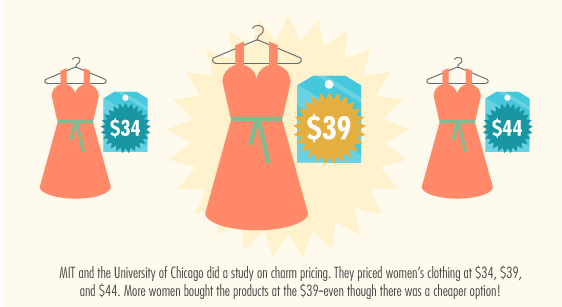
In fact, evidence from a December Washington Post article suggests that this charm pricing strategy -to make the house look more affordable- can actually result in a seller receiving 2% more on average than homes using a different strategy. And while 2% might not sound like much, consider that most buyer or “co-operating” agents earn a 2-2.5% commission for representing the buyer. In essence, with this strategy, you can have a buyer brought to your door for free.

There were more than a few highlights to the story, which I’d highly recommend reading in full at the source. That said, in an effort to summarize both the article & my thoughts:

1. Ignore the urge to meet search criteria. In a very aware move, the researchers asked buyers for their take on homes priced at a dead-even number such as $300,000. In theory, with so many buyers using auto-search criteria & Realtor.ca price ranges, evenly priced houses might show up in a few more searches than their unevenly priced counterparts. At $300k for example, you might show up in searches from $250k-$300k & $300k-$325k; a perceived benefit. In reality, feedback from buyers suggested that they felt sellers were just ballparking their asking prices and weren’t sure what it was really worth. On the other hand, a $299,900 list price looked like a bargain.

Charm Pricing

Source: Econsultancy/Arie Shpanya, 2014

2. Charm pricing promotes over-pricing. Just like in “The Goods” starring Jeremy Piven (an unjustly underrated movie, FWIW), the product doesn’t need to be a good deal- it just needs to look like it is. List prices designed to feel like a bargain didn’t end up being one for buyers. In fact, they were more overpriced than employers of any other pricing strategy… to the tune of about 5% each time. In the movie, Piven’s character, Don Ready, employs the classic “put a higher price sticker on the windshield, just to tear it off and close the guy with a bargain” move that car salesmen are known for. Home sellers do it too, whether they know they are or not.

3. There’s a method to the madness. Only 45% of listings took the charm pricing approach; with others deviating to the round-number pricing to fit search criteria, or an exact price (ie. $239,588, as if to suggest they just added up a bunch of receipts and this is their number). I can appreciate the merits of the round number pricing as more buyers turn to rigid search criteria online, however, only houses worth near to a major round number would even qualify for this strategy. Charm pricing appears in nearly every segment of our lives as buyers, from groceries to cars to shoes (as if to suggest women look at the prices of shoes), and there’s a reason for it. It works. It generates sales, while blissfully pulling the wool over buyers’ eyes. And as sellers, there’s nothing more you could ask for.


First-Time Buyers: Negotiating Your First Purchase

Negotiating a First Home PurchaseStellar, you’ve found the place for you. Maybe it’s home for 3 years, maybe for 10; but after all the searching on Realtor.ca, open houses, newspapers, private showings, you know this is the one you want. Now the question becomes, how do you lock it up and make it yours?

There two big factors in a first-time buyer’s favour when it comes to negotiating a deal on that perfect place. The first is flexibility, the second: cash.

I don’t mean cash as if the world is full of loaded 20-somethings, but rather that the math is all done and the money is there. You’ve been pre-qualified for a mortgage, you don’t have a house to sell and it’s just a matter of pulling the trigger. Many buyers who already own a home aren’t willing to sign an agreement on a new place until they have some assurance that they won’t be burdened with a pair of mortgages for an extended period of time. This means any first-timer’s offer at a similar price-point is more lucrative than one conditional on the buyer selling their current place. The less the seller needs to wait for and worry about, the better, and usually they’d be willing to sacrifice a few thousand dollars for a firm deal.

First-timers are also a pretty flexible bunch. Without kids in the picture, there’s less consideration for the timing of the move, which tend to occur most often when kids are on summer holidays. With a lease, or living at Mom and Dad’s, you can be flexible with your closing date to suit the sellers’ needs. If the sellers want to close in 2 weeks and all you have to do is lug your futon out of your parents’ basement, there’s nothing stopping you from doing it, and that’s rare.

The same flexibility that lets you choose your move in date can also give you the freedom to walk away from a bad deal. Use that to your advantage. If you’re shopping for a townhouse or in a newer subdivision, it’s easy to find the same floor plan for sale nearby. Don’t feel it necessary to overpay for a home that there are an abundance of, especially if you can afford to wait for another similar one to pop up.

There are other factors that can impact your strategy in negotiations- one of which is multiple representation. When an agent represents both the seller and you (as a buyer), they are bound in terms of what they can disclose about the other side. Essentially, calling the listing agent to see a property will put you in this situation every time; and it effectively removes the agent from the negotiating and turns them into a mere paper mule. Multiple representation limits the advising and strategy-planning role of the agent. Not only are listing agents constrained in consulting you as a first-time negotiator, they have an added motivation to put you in the house they’re selling. As a result, you’re better served as a buyer using an agent who will shop different houses with you- establishing a strong understanding of each other and strengthening trust along the process. That way, when you do settle on the right place, they know your needs, motivations and budget and also how to best negotiate on your behalf, representing you alone.

A good offer price is always subjective. Even though 2 agents on either side of the negotiation both likely know what the home is worth, they are only 2 of the 4 players in the game. Sellers may require a certain sale price to validate their move, and buyers often work within set budgets, so houses don’t always sell for their true “value”. Offering on a house differs given a number of factors including buyer & seller motivation, the length of time the house has been on the market, market value, the number of other interested parties, etc. Obviously you can offer lower on a home with a motivated seller whose house has been on the market for 3 months with no action than you should on a property that just hit the market and is likely to garner multiple offers. Situational awareness is key, and a good Realtor will know the signs to look for to get you the best deal.

Strong negotiating is an acquired skill. You don’t want to learn that the hard way on your first home purchase. Consider expert advice and put yourself in the best situation to make an informed decision, whether it be on your own or with an ally such as a Realtor on your side. It won’t cost you anything, so bringing in an agent to work for you is common sense. Failing to do you homework can lead to you not enjoying your first home for all it should be. Just remember, you only get one chance to buy your first house.

Which Renovations Should I Do Before I Sell? Probably None.

One of the most common questions I get from potential home sellers is: Should I do “project x” or leave it for the next owner? It’s not necessarily clear cut, but if you’re going to do something, you’ve got to do it well, and have buyers perceive it as better than the alternative. If you’re contemplating upgrading your linoleum flooring to higher-end linoleum, you might as well be taking cash from an ATM and stuffing it down a manhole. Things buyers would consider doing anyways (updating appliances, stone countertops, tearing out carpets for hardwood) are the way to create value.

Buyers these days have more refined taste than ever before, but often you’ll find two types of buyers: Those that want to save money and buy a home they can renovate, and those that are prepared to pay, so long as they don’t have to lift a finger once they move in. If you’re setting your home up to be somewhere in between these two markets, you’re destined to lose. With the former, they’re not typically willing to pay for things they’re just going to do over again. And buyers looking for turn-key homes don’t really care if the home is flashy if it isn’t cohesive.

For example, I went through a house with a re-done kitchen just this week and though the kitchen couldn’t have been but a few months old, the house still took on the “fixer-upper” stigma because of outdated doors & trim, holes in the drywall and ageing structural and mechanical components. There’s a difference between a “wow factor” (a term I hate, personally.) and lipstick on a pig. And it’s important to know whether buyers will see your reno work as the former or the latter.

In the Village by the Arboretum in Guelph, an adult-lifestyle community where I spend a lot of my time and resources, some sellers have installed new carpets, which they perceive as value-added finishes. After all, they often spend money to put in high-quality, plush carpets, and have them professionally installed. Unfortunately, most incoming buyers will see them as disposable as they look to upgrade to hardwood floors, and a detriment to the home. Despite the money put into new carpeting, the home is likely no more valuable in a buyer’s eyes, whereas it could’ve been had sellers made the move to hardwood prior to selling.

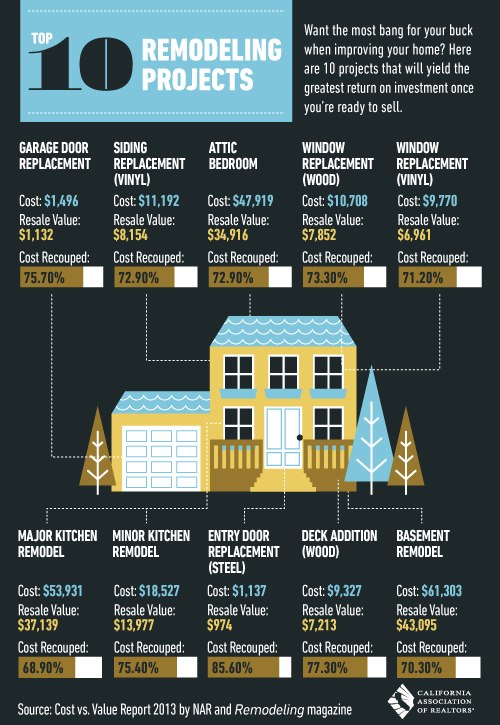
This infographic from the California Association of Realtors shows 10 key home renovation projects and the return on investment. One thing they all have in common: none generate a positive ROI. Odds are, most of the time, you won’t recoup the full cost of the reno. It’s not always explicit though. Sometimes, a house can be nearly impossible to sell with an outdated kitchen or a slew of mechanical issues, which makes some renovations necessities. Without some of the necessary renos, you’ll lose more money by reducing the price of a house that sits for sale without any action. That kind of situation makes dropping a few thousand dollars to make the home more saleable the best way to go. It’ll result in a faster sale, if not at a higher price point.

renoreturns

Before you choose to do any of the renovations you have in mind, have a Realtor conduct a market analysis on your home and the surrounding area. They can help advise you as to what kind of improvements will benefit you, and which will leave your bank account reeling. They can tell you the returns on those upgrades for your neighbourhood, and help you determine if they’re a project worth undertaking. Do the homework before you start and see the best returns, plain and simple.